
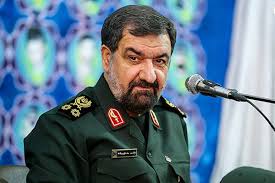
Interview of Major General Dr. Mohsen Rezaei, Former Commander-in-Chief of the IRGC, Member of Iran’s Expediency Discernment Council.
Source : Al-Mayaedeen, May 6, 2026
Translation: resistancenews.org
- 47 Years of Hostility and 70 Days of War
- The Strait of Hormuz: A New Instrument of Iranian Sovereignty
- The State of Negotiations and Iranian Demands
- Continuity and Legitimacy of the New Supreme Leader
- The Renewal of the Islamic Revolution
- The Gulf States: Brothers or Enemies?
- Hezbollah and the Axis of Resistance
- Israel, NATO, the World: The Shockwaves of Iran’s Victory
- 32 Million Iranians Ready to Take up Arms
The journalist’s questions are in Arabic; Mohsen Rezaei’s answers are in Persian, retranslated into Arabic by Al-Mayadeen.
JOURNALIST: Dear viewers, welcome. It has been approximately 70 days since the aggression against Iran was launched, and the language in Tehran has not changed — steady as its equations, sharp as its red lines, clear and leaving no room for ambiguity. No retreat on constants, no withdrawal when the confrontation touches fundamental principles. Here, time is not measured in number of days, but in the system’s capacity to endure and reproduce itself — a coherent structure for an Islamic system that expresses the new Iran, where popular presence is a constant in moments of trial: crowds renewing their allegiance, human chains proclaiming their readiness for the ultimate sacrifice should the need arise. A tableau that transcends mobilization to become a renewed Revolution. And at its heart stand figures who have never left their post in shaping decisions, holding the threads of the balance between the field and politics.
Our guest is a member of the Expediency Discernement Council, Major General Dr. Mohsen Rezaei — a man who has known the field as commander of the Revolutionary Guards for many years, and who has followed the transformations from within the inner circles of power. A personality who combines deep military experience with an influential political role, with a marked presence in policy-making and the formulation of options.
How does Tehran read this phase? What are the limits of constancy in the equation of conflict? And what options does the Islamic Republic hold between pressure and confrontation?
Welcome, General Mohsen Rezaei, to this episode and this exclusive interview. We thank you for the time you have granted us despite the security circumstances, and naturally given what is happening in Iran.
47 Years of Hostility and 70 Days of War
GENERAL REZAEI: In the name of God, the Compassionate, the Merciful. I am at your service. I extend my greetings to you in return. At the outset of my remarks, I wish to convey my greetings and respects to the beloved peoples of the region. First, I salute the souls of the martyrs of the Resistance, the oppressed martyrs of Lebanon, Yemen, Syria, Iraq, and the entire Islamic world. And then I extend my greetings and respects to the souls of the heroes of the Islamic world — Sayyed Hassan Nasrallah and his supporters who defended Islam, the Quran, Lebanon, and the Islamic world as mujahideen. I also extend my respects to all the mujahideen on the path of God, on the Axis of the Resistance — the Axis of Lebanon, Iraq, and Yemen. And my greetings to my dear brother Sayyed Abd al-Malik Badr al-Din (al-Houthi, leader of AnsarAllah), who bravely leads the valiant Yemeni people, fighting on the path of God.
As for your question, allow me to begin with a verse from the Noble Quran. I believe this verse corresponds to the current conditions in the Islamic world. The Noble Quran says, in Surah Al-Hajj (in Arabic):
“And strive in His cause as ye ought to strive, (with sincerity and under discipline). He has chosen you, and has imposed no difficulties on you in religion; it is the cult of your father Abraham. It is He Who has named you Muslims, both before and in this (Revelation); that the Messenger may be a witness for you, and ye be witnesses for mankind!”
I will return to this blessed verse and explain why I chose it to open my remarks.
In truth, the Islamic Revolution in Iran aimed at independence after two centuries of dependence. For those two centuries, we were colonized — by the British, the Americans, the Russians, and the European powers. We fought them, we resisted them, on multiple occasions and in successive events, such as the oil nationalization issue. When Imam Khomeini arrived, he presented a complete model for the independence of the Iranian nation, and this was expressed in the Islamic Revolution, under the slogan of independence, freedom, and the Islamic Republic. After 2,500 years, the monarchical system was abolished and the Islamic Republic was formed. Its beginning was marked by the struggle against the arrogant powers (imperialists) and the political struggle against the United States.
Our struggle for the defense of Muslims was usually conducted through non-military means, by supporting Muslim peoples. But these last two years, approximately, the United States has transformed its political war against us into a military war. And after approximately 45 years, our war against Israel and the United States has become a military war. We are now in entirely different circumstances, and we must triumph completely, just as we have achieved successes and victories. I will present an account of what we have accomplished in this war.
But we will not allow the United States to close the matter by fleeing the region. In the new circumstances, in order to open the Strait of Hormuz, they want to deliver a dramatic show of force and then flee the region. We will not allow that. This is a battlefield, and we must reach the final outcome in our confrontation with the Americans and obtain what is owed to us from this war. They must compensate us for the losses we have sustained. And even if they flee to the United States, we will certainly obtain our rights and reparations for our losses. We have endured against them for 47 years, and today we will continue our Resistance.
JOURNALIST: General Rezaei, you are with us today in the uniform of a Revolutionary Guards commander. How can this phase be characterized? Are we facing a continuing war despite what the Americans have announced about a unilateral ceasefire? And what of Iran’s military preparations in the face of existing threats?
GENERAL REZAEI: The Americans must remove their hands from the oil in the Persian Gulf. They entered the region believing that, following the defeat or failure of the Soviet Union, they could fill the vacuum in the region. Bush wanted to attack the region but was unable to do so. And now Trump is repeating this failed scenario in a different form, seeking to fill the power vacuum in the region alone. This will not happen and will not come to pass.
The Persian Gulf must be an independent gulf, which cannot be drawn into future equations between the United States and China. We are an independent region. We, along with Saudi Arabia and Turkey, must continue to advance as an independent region. Therefore, American intervention is a foolish act. They themselves have acknowledged that this war is a blind war. Now I say that this war is not only foolishness but also ignorance, and it was also a great crime. The Americans want to achieve a victory and flee the region, but the road before them is blocked. They cannot retreat, because they have become isolated in the world, and even their former allies no longer help them.
The Strait of Hormuz: A New Instrument of Iranian Sovereignty
JOURNALIST: Very well. The Strait of Hormuz is today, Dr. Rezaei, the code of this war, one might say. Starting from this strait, how is Iran planning today to engage with the new international order, as you describe it, from its control and management of the Strait of Hormuz?
GENERAL REZAEI: The Strait of Hormuz, unlike all other straits in the world which have two sides, this strait in the region has four sides — and three of those sides are in Iran’s hands, and one side is in the hands of our brothers in Oman. This is why one can say that the Strait of Hormuz passes through the interior of Iranian territorial boundaries.
And they have used the Strait of Hormuz against the Iranian people. You remember, and the peoples of the region remember: in the era of Saddam Hussein’s aggression against Iran, hundreds of ships carrying weapons and ammunition destined for Saddam Hussein passed through the strait, and he used them against us. But we endured that. And in this last 12-day war (June 2025), the Strait of Hormuz and the Persian Gulf were used against us. In this war, the United States and Israel used the Strait of Hormuz against us.
Our first objective in the Strait of Hormuz is security — establishing security for Iran and for the entire Persian Gulf region. If the Strait of Hormuz escapes once again from Iran’s control and management, the enemy will use it again against Iran and the Iranian people.
The second subject is that of trade. We consider it our duty to ensure trade in the region. We control three sides — three flanks of the strait — on Iranian territory. Of course, establishing this security has a cost, and we must collect that cost from the Strait of Hormuz.
The State of Negotiations and Iranian Demands
JOURNALIST: Very well, Dr. Rezaei. As you know, there are many leaks in the media, and even from Iranian officials, regarding the Iranian proposal or initiative presented in Islamabad in recent days. We would like to understand from you how Iran orders its priorities today in this proposal, how it was presented, and whether there has been a response from the other side.
GENERAL REZAEI: Our conduct in this war has been a logical conduct. First, we seek not to step outside the framework of international rules and norms, whereas the enemy does. We seek to ensure that the military confrontation against the United States and Israel does not affect humanitarian affairs and ordinary civilians, whereas they kill civilians in Iran. The Iranian war carries a humanitarian message and a message of resistance.
This is why we have accepted that negotiations take place in parallel with the war. We could, given the distrust of Trump and his associates since the previous war, have declined to enter negotiations. But the matter was presented in detail to our martyred Guide, and despite the fact that they attacked us in the middle of negotiations, the decision was made to pursue them on the basis of a humanitarian spirit, because we have an ethical framework that the United States does not possess. After 12 days, Netanyahu asked Trump for a ceasefire. Trump contacted Sayyed Araghchi (Iranian Foreign Minister) and requested a ceasefire. Iran accepted.
And six months later, they carried out a failed military coup in Iran. We could also have halted all negotiations with the United States, because the United States supported that coup, and Trump himself announced: “I provided weapons to the coup plotters.” Nevertheless, in accordance with the same humanitarian and ethical rules, we accepted to resume negotiations. And they, once again, violated commitments and covenants, and launched the Ramadan War (on February 28, 2026).
Of course, the United States emptied the negotiations of their substance. But the Pakistani Prime Minister called Iran and said that the United States had declared its agreement to the Iranian conditions. We had 10 conditions which we submitted to the Americans. The Pakistani Prime Minister announced the United States’ agreement to these conditions, and we asked that the United States formally declare its agreement, which they did, in summary.
On the basis of the same rules and the same humanitarian spirit, we were opposed to the continuation and expansion of the war in the region, and we accepted negotiations and went to negotiate. But Vance and his team, from the very first day, made statements that contradicted their initial agreement to the Iranian conditions. This is why we stopped. The negotiations were suspended. They asked for a ceasefire once again and we opposed it. And we are currently in a state of military silence.
And the last day before the expiry of the ceasefire, two weeks ago, they entered the Sea of Oman with all their frigates and warplanes in the Sea of Oman and the Indian Ocean to encircle Iran. They requested negotiations once again. We announced our conditions: the United States, before negotiations, as preconditions, must agree to compensate Iranian losses, release frozen Iranian funds, and other conditions were added. And we are ready and mobilized in our defensive preparations, and we will certainly obtain reparations for our losses from the Americans.
Continuity and Legitimacy of the New Supreme Leader
JOURNALIST: Let us speak of the internal situation in Iran today. How are affairs being managed, especially following the assassination and martyrdom of the Sayyed of the Umma, Ali Khamenei? There was an unprecedented situation — we know that the choice of Sayyed Mojtaba Khamenei was not planned as Supreme Leader of the Revolution. How did it unfold? How was his name put forward? What was the process of selecting Sayyed Mojtaba as Leader of the Revolution and the Islamic Republic of Iran?
GENERAL REZAEI: The Iranian people can be considered the most experienced and battle-hardened people in building an Islamic state. We drafted the first Islamic Constitution more than 100 years ago. And from then until the victory of the Islamic Revolution in 1979, we had great debates about state-building and drafting the political system in Iran. This is why the current political system in Iran enjoys a foundation of support stretching back more than 100 years.
The political system, elections, popular sovereignty, the relations between the powers, the relationship of the powers with the Supreme Leader of the Islamic Revolution — all of this has been clearly defined. Our martyred Leader managed Iran under various governments; more than 30 elections have taken place in Iran. There is therefore no ambiguity in the activities of the Leader, in his relations with the powers, in his leadership of the armed forces.
And in particular, our dear current Guide, by virtue of having accompanied the martyred Guide, benefits from all the experience accumulated over more than 30 years. The experience was transmitted to him. He does not therefore start from zero in managing Iran; he has sufficient experience. And today affairs are under his control and we are moving forward.
He is the supreme commander of the Iranian armed forces. He leads the country, he leads the Revolutionary Guards, he leads the army and the police. At the head of these forces are the general staffs. There is a hierarchy, and he commands all of these forces. And likewise, the three branches of power in Iran are independent powers — their relationship with the Guide is very precisely defined in the Iranian Constitution and has been rigorously tested. This is why, in the words of scholars today, the Islamic Republic has transformed into a solid institution, from the top to the base.
JOURNALIST: Very well. We pose the question here: what was the impact of the martyrdom of Sayyed Ali Khamenei on Iran? How was Iran able to continue after him? This period between the martyrdom of Sayyed Ali Khamenei and the election of Mojtaba — there was an American-Israeli wager on the fall of Iran during this period.
GENERAL REZAEI: One of the greatest problems of the enemy in facing the Islamic Republic — and the United States in particular — is that they do not know the Iranian people and Iranian history precisely, and they have no knowledge of Iran’s internal political relations.
For example, when there are demonstrations, they think it is like in the arrogant (imperialist) countries. They then support the demonstrators and expect the fall of the regime. But the table turns against them, and the demonstrators face them down.
One of the important points in Iran is the people’s trust in the various governments, on the basis of the opinion of the Leader of society. They know that when there are divergences between the different forces and powers in Iran, they trust the word of the Leader in Iran. But the enemy thinks that this is an indicator of the fall of the Iranian system, and this dream has never been realized and will never be realized.
Some say: “The martyred Imam has died, how can the Islamic Republic continue?” But I tell you that the Islamic Republic continues in a stronger manner, and these victories have been achieved by virtue of this martyrdom.
The process of selecting the Leader of the Islamic Revolution transcends individuals, parties, and political factions. There is no particular party, for example, that gathers and chooses the Leader. Why? Because there is the Assembly of Experts, whose members are elected by the votes of the people. And when the people choose their experts — those who have the capacity to discern the most qualified to lead — the Assembly of Experts being composed of more than 80 persons, the mandate of this Assembly is eight years, and elections are held every eight years. When the Leader of the Islamic Revolution passes away or is martyred, they convene and study a number of candidates. For example, in this election, there were five or six candidates for leadership. But the majority of members voted in favor of Sayyed Mojtaba Khamenei, in a fully democratic process, on the basis of the people’s election of their experts, and the people’s experts choose the Leader. This is why the choice of the Leader in Iran belongs neither to a single person, nor to a party, nor to a particular clan.
On the other hand, this process lasted nine days. How did Iran hold and resist during those days without a Leader? In most countries, if circumstances took this turn, coups would occur. Why did we not observe this in Iran? Because in Iran there exists a Leadership Council, and this Council manages the affairs of the country during the period of power vacancy. The world must conclude that when Iran resisted during this period, they must draw the conclusion that it is not possible to cause the Islamic Republic to fail or to defeat it. The Islamic Republic stands and resists. These nine days — from the assassination of the martyred Leader to the selection of the new Leader — are the best proof of this. On this basis, politicians and the people in the United States must blame Trump for this.
The Renewal of the Islamic Revolution
JOURNALIST: Very well. Starting from this reality, are we today facing a new Iran and a renewed Revolution? Especially during this war, and the painful strikes that Iran has delivered — particularly the strikes carried out in response to the targeting of energy installations and Kharg Island — the scale of the strikes directed against energy installations linked to American-Israeli interests in the region surprised everyone. Has Iran therefore abandoned today the policy of strategic patience?
GENERAL REZAEI: Yes, that is correct, and it is indeed the case. We will not return to the Iran of before the 12-day war.
Today, there are two models. The first model: Trump and Netanyahu want to change the map of Western Asia (the Middle East), and a large number of sovereign countries — they want to modify their borders: the borders of Lebanon, the borders of Syria, the borders of Saudi Arabia, Jordan. They want Israel to advance again toward the Sinai Desert. Today, had they succeeded in their attack against Iran, they would have attacked Egypt. But they have reached the conclusion that they cannot change the map of Western Asia without defeating Iran and changing the map of Iran.
And are we going to leave the battlefield today? Even if we were to leave, they would not stop at their current borders. They wanted to divide Iran into five states, Iraq into three states, Syria into three states, and to offer southern Lebanon up to the Litani River to the occupying entity.
Facing this model, we have a new model and a new design: namely, that the countries of the region must themselves ensure the security of the region, and foreign forces — whether American or European — must leave this region. We can ensure the security of the region ourselves. And we want to establish a Regional Security Council. There are great powers in the region — Iraq, Egypt, Pakistan, Saudi Arabia. We can ensure the security of the region.
Why pay the costs of the American-Chinese war? We do not want to be drawn into the equations of the great powers in the West or the East. We have a plan and we continue to execute it. And we are certain that the United States will decline day by day and will ultimately fall, that the usurping entity will collapse, and that security will be restored in the region.
The Gulf States: Brothers or Enemies?
JOURNALIST: Very well. Speaking of the region, how does Iran perceive its relationship with the countries of the region today, especially the Gulf countries? And how does it view these countries today — does it view them equally? Because there is also a debate about the Emirates, about the American-Israeli-Emirati alliance in the region. How does Iran deal with it?
GENERAL REZAEI: The Islamic Revolution was a very good opportunity to create fraternal relations between Iran and the Persian Gulf countries. Why? Because we overthrew the Shah’s regime, which was allied with Israel. We overthrew it. And in Iran, we revived Islam alongside Iranian patriotism. So why did the Islamic countries of the Persian Gulf not support the call of Islam in Iran? Why did they not welcome our struggle against Israel?
The Persian Gulf countries supported Saddam in Iraq for eight years of war. In the Strait of Hormuz, we saw and observed daily ships flying Kuwaiti, Qatari, and Emirati flags transporting weapons and ammunition to the Baathist army in Iraq, which was bombing us. They passed before our eyes in the Strait of Hormuz. We endured, we persevered, and we said they are our brothers — but the United States had incited them.
After the end of the Iran-Iraq war, did we resort to revenge against them? Did we seek to take revenge? No. On the contrary, the beloved peoples of the region must know that more than 600 billion dollars of Iranian money went to the countries of the region — to Dubai, to Abu Dhabi, either in investment or in trade. It is essentially with Iranian money that the Emirates were built and prospered. Was it right for the Emirates to ally itself with the occupying entity and bring its spies alongside the Iranian islands, bring Israeli spies alongside Iranian territory? They are the ones who stand accused.
Our friends in Saudi Arabia — a suspect group attacked the Saudi embassy in the region, and our friends in Saudi Arabia became angry with us, although this action did not come from the Iranian side and we did not condone it. But after that, did we seek revenge? Our friends in Pakistan renewed the pact of brotherhood between us and Saudi Arabia. Then, in the embassy affair, tensions arose. And then Mr. Shamkhani in China concluded a friendship agreement with our brothers in Saudi Arabia.
Consider: throughout all these 47 years — despite the cooperation of a number of these countries with Israel and their participation in the war against us — we have not demanded revenge from them, we have not taken revenge. And until today, American bases in the Persian Gulf countries — if the attack against Iran is launched from these bases — when they attack us, are we going to sit and watch without retaliating? But the Emirates, unfortunately, have acted badly toward us, and until this day we have restrained our anger. But my question is: this verse from the Noble Quran that I read before you — this blessed verse says that the Prophet Abraham, peace be upon him, named you Muslims before:
“It is He Who has named you Muslims, both before and in this (Revelation); that the Messenger may be a witness for you, and ye be witnesses for mankind!”
And you are witnesses over the peoples of the world. O Muslims, such is the mission of the Seal of the Prophets — it is your duty to fulfill it. In the era of the Seal of the Prophets — may God’s prayers be upon him and his family — it is for you to be a beacon of security and justice in the world. You must support Muslims and stand alongside the fighting Muslims, and you must stand with the Muslims.
The Abraham Accords — this agreement is between Muslims and not with unbelievers, because Abraham had established reconciliation between you long ago. Is it right that, when the Quran asks you to be witnesses over all the peoples in the world, some should stand alongside the occupying entity? 72,000 martyrs in Gaza, more than 6,000 people have lost their limbs in Gaza. Look at Lebanon, what is happening there. Certainly, God Almighty is not satisfied and is angered by this. The Prophet — may God’s prayers be upon him and his family — is not satisfied either.
We Muslims must stand alongside one another. How can we stand alongside the enemies? We must unite with one another and not align ourselves with unbelief.
You have seen what a slap we have delivered on the face of the United States. I hope we will stand alongside one another, in solidarity, and that this reconciliation will be among Muslims and not with the unbelievers.
Hezbollah and the Axis of Resistance
JOURNALIST: Dr. Rezaei, Iran always emphasizes the necessity that any ceasefire agreement with Washington include Lebanon, of course. But to what extent can Iran hold to this demand? And what is the nature of the relationship today with the Islamic Resistance in Lebanon? How would you describe it?
GENERAL REZAEI: The first time I came to know Lebanese territory was when Israel entered Lebanon and advanced to Beirut. I went there with a number of friends and I saw the oppression of the Lebanese people. This is why Hezbollah did not bring the war into Lebanon, but rather Hezbollah was born in the occupied Lebanese alleyways. This is why the Lebanese president’s statements claiming that Hezbollah provoked the war are incorrect. No — Hezbollah was formed to defend Beirut, and Beirut was the first Arab capital which Israel entered. This is why today’s Hezbollah, which was formed to defend Lebanon, has become a strong and great tree.
Of course, we have been influential in the defense of Lebanon and the Lebanese people, and in the defense of the Lebanese army. And today also, I declare firmly that we will stand alongside Hezbollah and that we will defend alongside Hezbollah and the Lebanese people with strength, and we will defend the Lebanese army without ever hesitating. Certainly, if there is a ceasefire, it must include Lebanon as well. The enemy has no other choice but to accept — it must cease all aggression against Lebanon.
JOURNALIST: It must therefore cease these aggressions. So what is Iran seeking to draw today at the regional level through its responses to the American-Israeli aggressions and through the consolidation of these gains after this war?
GENERAL REZAEI: Today, the discussion has two aspects. The first is the Axis of Resistance — and thank God, there is a union within the Axis of Resistance which we support: AnsarAllah (in Yemen), Hezbollah, the Popular Mobilization Forces in Iraq, and all members of the Axis of Resistance defend their peoples against the “Greater Israel” project and the project of changing the map of Western Asia. We therefore regard these countries as part of our security. If Israel wants to change the map of the countries of the region, that also targets Iran. And because we rise in defense of Iran and in defense of Islam, we stand behind the Axis of Resistance.
But the other aspect is the question of Iran itself: we are serious in the defense of Iran in the region of the Persian Gulf and the Strait of Hormuz. The enemy, due to its loss of the Persian Gulf, has positioned itself in the Sea of Oman and the Indian Ocean. But this is not an appropriate place to be positioned. The United States had 16 bases in the region; they cannot remain in the Sea of Oman and the Indian Ocean because they lack military bases in that ocean and that sea. The future of the United States before us is therefore entirely clear: it will be eliminated and will disappear, God willing. And the future of the path we have taken is bright and very honorable.
Israel, NATO, the World: The Shockwaves of Iran’s Victory
JOURNALIST: And what of Israel today? Israel before the Al-Aqsa Flood is no longer the same as after it, of course. How does Iran also deal with this threat?
GENERAL REZAEI: The occupying entity has committed an enormous act of suicide. If, for example, Israel still had 15 years to live, this step of Netanyahu’s has shortened Israel’s lifespan. And those in the world who supported Israel have today become enemies of Israel. And even the statistics show a sharp rise in the level of hostility toward Israel. And it is also evident that Israel has dragged the United States into the war and inflicted considerable losses upon it, of which the American people — to whom they rightfully belonged — have been deprived. In these wars, the first victim is the occupying entity.
This does not mean that if the United States leaves the region, Israel can survive in the region. No: we regard the occupying entity as a finished project. Once, the British were in the region, and they left. The Portuguese were there, and they left. The Americans will leave too. And we and you, we will remain in the region. And Israel must take this into account.
The other subject is that the Iranian victory over the United States has led to a great shock and a great earthquake in the United States’ political relations with the world. First, American relations with NATO have weakened — there is a major fracture between the two sides. Today the Arab countries see that these exorbitant costs that the United States has extorted from them are ephemeral and disappearing, and they are now thinking about the world — the region — without an American presence.
And the same applies to the relationship of the United States with Canada, with the West, with the continent of South America, and even American-Indian relations. And also the fracture between China and Japan has widened. And the Chinese are thinking about taking control of the island of Taiwan. And Russian tensions with the Europeans have grown. And all of this is the result of the United States’ failure before Iran, and Iran’s victory has led to a great shock in the region.
JOURNALIST: Very well. I would like to return with you, Dr. Rezaei, to Islamabad specifically. What is Iran seeking to consolidate in any future round of negotiations in Islamabad? And why does it refuse to discuss the nuclear dossier and matters concerning the nuclear program?
GENERAL REZAEI: On the question of the nuclear program, Iran speaks with no one. On the question of the Strait of Hormuz, all matters are clear. To free themselves from Iranian anger toward them, the United States must move forward and gain the confidence of the Iranian people. The Iranian people and the Iranian government do not trust the Americans. And there are preconditions that the United States must fulfill. The least costly path for the United States is that of compensating for Iranian losses. When these conditions are met…
JOURNALIST: What are these conditions, Dr. Rezaei? Excuse me for interrupting.
GENERAL REZAEI: We have announced them through the ten points; we announced them previously, and the Pakistani Prime Minister announced them to the other party. But due to the other party’s escalating demands, we have imposed a precondition that the United States must fulfill and meet.
Reminder: Iran’s 10 points that led to the April 7 ceasefire
1. Commitment to non-aggression
2. Maintenance of Iranian control over the Strait of Hormuz and collection of transit fees
3. Acceptance of uranium enrichment
4. Lifting of all primary and secondary sanctions
5. Repeal of all UN Security Council and IAEA Board of Governors resolutions
6. Payment of compensation to Iran
7. Withdrawal of U.S. combat forces from the region
8. Cessation of hostilities on all fronts
9. Release of all Iranian assets frozen abroad
10. Approval of all these provisions in a binding Security Council resolution.
JOURNALIST: On this specific condition — what is it?
GENERAL REZAEI: I have indicated it: we have approximately 150 to 200 billion dollars in losses that the Americans have caused us, and they must pay for these losses. There are billions of dollars in the United States that are frozen — they must release them. And commit to not repeating their aggression.
JOURNALIST: How are the negotiations managed today, Dr. Rezaei? And how does Iran balance the military and diplomatic tracks?
GENERAL REZAEI: The Iranian system and the balance it achieves between the battlefield and diplomacy is a defined course. And we have very great experience in this domain, especially the eight-year war with Saddam Hussein. There was an Iranian team led by Dr. Velayati on the diplomatic track, and myself and the martyr Sayad Shirazi led the military track. And Sayyed Hashemi Rafsanjani represented Imam Khomeini on the battlefield. All these matters were raised in the Defense Council, then the results were presented to Imam Khomeini, and decisions were made. This is an experience that has been crowned with great success — we have practiced it for eight years, and we benefit from it today. And the Guide of the Islamic Revolution also manages both the diplomatic and military domains; matters are submitted to him, he presents his opinions, and they are applied.
JOURNALIST: Very well. Speaking of Sayyed Mojtaba Khamenei — there are great questions today: why does Sayyed Mojtaba not appear before the people in image and voice? These are questions we convey, of course, on behalf of the people.
GENERAL REZAEI: This will happen. It will come to pass. The reason is a matter of security planning and protection, and the reason is clear: the Zionist entity wants to carry out a number of assassinations in Iran. But after this, we will deal seriously with the question of the Leader. The martyred Leader did not accept that things be made complicated to this level, and he was martyred in his office. And since we want to inflict great losses on the American and Zionist enemy, we will take the protection of the Leader more seriously, even if he wishes to appear before the people.
JOURNALIST: Very well. But despite this, the messages of Sayyed Mojtaba Khamenei find attentive ears in Iran, especially when we speak of the fact that for approximately 70 days, the Iranian people continue to take to the streets, to be present in the squares, creating this tableau. So of what image are we speaking today? Of the Iran of a renewed Revolution — people and leadership as one?
32 Million Iranians Ready to Take up Arms
GENERAL REZAEI: There is truly a Revolution and a renewal that have been realized in Iran. Why? Because a number of veils that the enemies had created to obscure Iran — today we have torn away these veils. The veils of falsification have been torn away. And the people have seen with their own eyes that Trump and Netanyahu, when they announce that they want to help the Iranian people, have understood and realized that they are the true enemies of the Iranian people.
Billions of dollars have been spent on satellite channels and in the media domain, and when Iranians went outside of Iran — they did not allow the voice of truth to reach these people. But these veils have today been torn. And the people have well understood that they were preparing to steal Iranian oil, that they are thieves, and that they want to return Iran to the stone age and the distant past.
This is why even those who previously approved of Trump and Netanyahu have taken to the streets in support of Iran.
JOURNALIST: Very well. From this, one reads the 30 million who registered in the “My soul in sacrifice for Iran” campaign. This approach also — how can it be described — popularly, militarily, and in the face of this continuing aggression?
GENERAL REZAEI: Among those who have registered their names — whose number has reached approximately 32 million — approximately 50% have declared that they are ready and willing to bear arms against the enemies. And if they enter into war with arms, who can stop them? Their addresses are there, their phone numbers are there. Another 15 million have declared that they are fully ready for financial support, cultural support, and all support that can be provided behind the scenes — in the matter of aiding the wounded, conveying aid to the forward lines and front lines of battles. These people who offer their souls for Iran are a manifest indicator in this Revolution.
JOURNALIST: After this tableau painted by the Iranian people, are there fears or indicators among the authorities in Iran today of a return of the acts of sedition that took place previously, and upon which the American president and the Prime Minister of the occupation have recently placed their bets?
GENERAL REZAEI: After these events, it is natural that their internal attempts will weaken considerably. Because a number of these demonstrators and troublemakers have themselves declared their readiness to fight the United States — those who had objections three months ago. This is why we have nothing but despair for the United States — they are without doubt desperate. They will try once more. The production of certain goods may have decreased, prices may have risen, and they want to open an account on this issue of price increases that have occurred in Iran following the strikes on petrochemical installations and steel factories. They have wagered on this to bring people out to the streets. But the masses who take to the streets will certainly cry: “Death to America!” and “Death to Israel!”
JOURNALIST: Unfortunately, we have reached the end of this interview. We thank you for your time and your frankness, ajor General Dr. Mohsen Rezaei, member of the Expediency Discernment Council. Dear viewers, we have thus reached the end of this exclusive interview. May God keep you safe.
To support our work, you can donate, share this article and subscribe to our newsletter. All the donations will be sent to Lebanon to help the refugees.
 Resistance News Unfiltered