
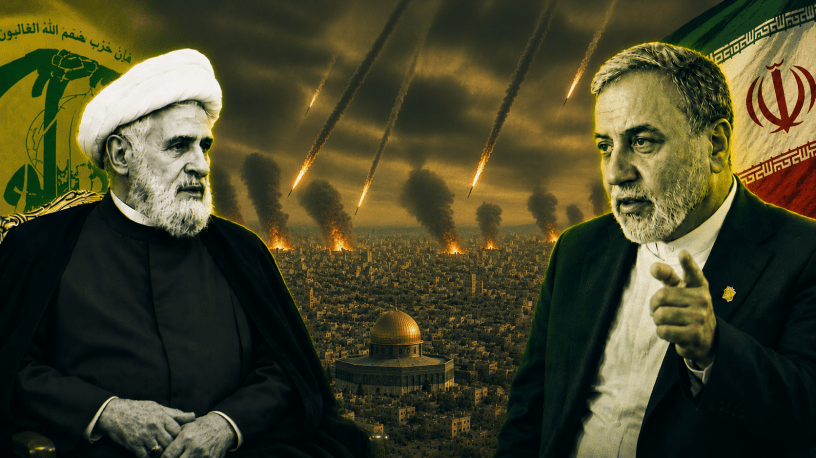
Interview with Sayed Abbas Araghchi, Foreign Minister of the Islamic Republic of Iran, on the pan-Arab Lebanese pro-Axis of Resistance channel Al-Mayadeen, June 3, 2026.
Source: YouTube
Translation: resistancenews.org
JOURNALIST: Welcome, Minister, Dr. Araghchi, to this exclusive interview. Thank you for accepting the invitation and for granting us this moment during this particular, precise and extremely sensitive period. We should perhaps begin this interview by addressing the general framework of the inflamed war and the Iranian situation, but allow me, Minister, to start with the file we consider extremely pressing: the Lebanese file. Just two days ago, we were on the verge of a barbaric, massive and ferocious Israeli aggression — not on Lebanon and its South, since that is already happening, but on its capital Beirut and its southern suburbs. The entire world spoke of it, and Iran took a position. Minister, please, to begin: what do you say about this pressing file, about the aggression that was imminent against Lebanon?
MINISTER ARAGHCHI: In the Name of God, the Merciful, the Compassionate. First of all, I welcome you and I thank you for this invitation to this programme. It is an honour for me to appear on the Al-Mayadeen network. I thank you for the kind words you addressed to me and for your benevolent regard.
Regarding Lebanon: we consider Lebanon, under all circumstances, a friendly and brotherly country. We have never sought to interfere in Lebanon’s internal affairs. We had viewpoints and observations which we expressed. As for Hezbollah, as an essential component of the Lebanese political structure, it is natural that we support and defend its principles — but we have never been behind any interference in Lebanon’s internal affairs.
However, in this latest war between Iran and America, Lebanon is an inseparable part of Iran. This war pits Iran against America and Israel, the Zionist entity, and Lebanon is naturally a full component of it, all the more so since it has suffered aggressions throughout this war. This is why we consider that the fate of Iran’s war against America and Israel cannot be separated from the fate of the war in Lebanon, and that there exists a deep link between the two.
From the very first day that the question of negotiations, the ceasefire, and the end of the war was raised, our position was very clear: the end of the war and the ceasefire had to concern Iran and all the fronts of the Resistance, particularly Lebanon [and presumably Gaza]. On this point, we have been consistent. When the war and the ceasefire were concluded, during my conversation with the respected Pakistani Prime Minister, Mr. Shehbaz Sharif, I told him plainly and requested expressly that when it is said that the war stops on all fronts, the word “Lebanon” in particular had to be inscribed in the text — and that is ultimately what took place.
But today as well, in the negotiations we are conducting to reach a memorandum of understanding with the United States of America — which are in their initial phase — the first point is the end of the war, and in the very first sentence, we stipulated the cessation of the war on the entire Axis of Resistance, and first and foremost in Lebanon.
Lebanon, in this war that was imposed upon us by America and Israel, has paid a heavy price. We will never forget the Lebanese people, our friends and loved ones in Lebanon who were targeted by Israel. And certainly, our fate is one when it comes to ending this war — in Iran, in the region, and in Lebanon as well — that fate will be bound and shared.
JOURNALIST: What does “our fate is one” mean concretely when it comes to the end of the war?
MINISTER ARAGHCHI: It means that either the war will stop in Iran and in Lebanon simultaneously, or it will stop in neither Iran nor Lebanon.
JOURNALIST: Dr. Araghchi, frankly, over these past two days, a great deal of information has circulated. Some said that it was Trump himself who halted the Israeli aggression against Lebanon; others said it was the Lebanese authority; still others mentioned Arab countries, pressures coming from here or there. Setting all of that aside: what precisely was Iran’s role, on the military, political and diplomatic levels?
MINISTER ARAGHCHI: I believe, in my assessment, that what brought the war to a halt within two days was above all the capacity of the Resistance, the capacity of the Iranian armed forces and of the Lebanese Resistance. For when the forces of the Zionist entity considered attacking the southern suburbs, we adopted a firm and categorical position, and our armed forces prepared to retaliate.
For several days now, as Israel has been violating the ceasefire concluded between Iran and America, as well as the ceasefire in Lebanon, these violations have been met with responses from Hezbollah. However, a violation of the ceasefire in Beirut constitutes a major act of aggression. We made it known to all parties that if Beirut were attacked, we would not tolerate it, and that from the Iranian standpoint, the ceasefire between us and America and Israel would be considered void, and our armed forces would retaliate. I conveyed this message to the Americans, as well as to our friends in the region. That night, I contacted the relevant countries and told them unambiguously that if the Israeli aggression intensified, the war would resume and it was our duty to face it.
I thank all the countries of the region that contributed to this effort, that mobilised and contacted America, exerted pressure on it. And ultimately, Israel’s attack against Beirut’s suburbs was stopped by America — the reports exist in the media as to how this occurred.
What determines the fate of the war is therefore the capacity of the Resistance and the capacity of our armed forces. Through their powerful responses, they will make the enemy regret its actions. That night, we adopted a firm and categorical position. Our armed forces issued a communiqué, as did the Khatam al-Anbiya headquarters, which issued a clear statement. Diplomacy also adopted a clear position, and the result was that the Zionist entity backed down and renounced its attack against Beirut’s southern suburbs.
JOURNALIST: Yes, we read and followed the communiqués from the armed forces, from Khatam al-Anbiya to the Revolutionary Guards. But were the Iranian armed forces truly ready, operationally, to resume the war and to strike Israel if Beirut and the suburbs had been invaded or attacked?
MINISTER ARAGHCHI: At any given moment, our armed forces are ready for that.
JOURNALIST: On that day, were they truly ready to strike Israel if it had struck the suburbs and Beirut?
MINISTER ARAGHCHI: Absolutely, yes. And this is not the first time. Several weeks ago, we found ourselves in these same circumstances, and our armed forces had threatened to retaliate and attack Israel — which led to the ceasefire in Lebanon. The night before last as well, this led to the halting of the attack on Beirut. Our armed forces have extremely firm and categorical positions in such situations, and at any moment, if the ceasefire is violated, they will assume their responsibilities.
JOURNALIST: Is the exchange of documents and the continuation of negotiations [between the United States and Iran] still ongoing, or suspended due to the position on Lebanon, the southern suburbs and Beirut?
MINISTER ARAGHCHI: All negotiations are influenced by external factors — that is natural. At present, the format of the negotiations is not in place, but messages continue to be exchanged. Two days ago, we sent a message to the Americans regarding the necessity of halting the Israeli aggression against Beirut. Our relations and communications have not been severed. But for the past several days, on matters pertaining to the negotiations themselves, no progress has been made: both parties are studying the texts that have been exchanged and working on their final formulation. As soon as favourable conditions materialise, we will return to the negotiations — on the basis of Iran’s national interests, the rights of the Iranian people, and peace in Iran, in Lebanon, and in the region.
JOURNALIST: Minister, I am addressing a foreign minister, not just any political analyst. We are therefore looking for a position, not an opinion or an analysis. That said, I put this question to you drawing on your experience: what is it that personally drives Trump to threaten and speak to Netanyahu harshly — even with marked severity — regarding Lebanon and the necessity of halting the attack on the suburbs?
MINISTER ARAGHCHI: What I am about to tell you is not analysis — these are facts that I am conveying to you. The Americans, in this latest war — the forty-day war, the Ramadan war — concretely felt Iran’s real power. They understood this strength and this capability. Before this war, they imagined that Iran was a weak country in West Asia [the Middle East]. It was on the basis of this representation that they launched the twelve-day war last June, and then the forty-day war.
In the forty-day war, they mobilised all their capabilities, all their forces, everything they could assemble on the ground. They deployed every preparation to overcome Iran within a matter of days and force it to capitulate — but this never happened.
In this forty-day war, America used everything it had. Their first demand — as announced by Trump from the very first day of the war — was unconditional surrender, and this never happened, absolutely never. They pursued unrealistic demands such as regime change — that too did not happen. They attempted to inflame tensions between the various components of Iran [in particular the Kurds] and to provoke a civil war — that too did not happen. They thought the people would take to the streets against the regime: the people did indeed take to the streets, but to support the regime of the Islamic Republic of Iran and to oppose the aggression imposed upon the country.
All their calculations were wrong. They wanted to annihilate Iran’s ballistic capability — it was not annihilated. They had other demands that were not realised, and ultimately they were compelled to ask for negotiations.
Iran’s true power, in my view, manifested itself clearly in this war — for the Zionist entity, for America, and for others as well. This is why, when Iran declared with absolute firmness that if Beirut were attacked, the response would be equally absolute, they were compelled to reconsider their calculations.
JOURNALIST: Does this mean that Trump, in your assessment, does not want to return to the war?
MINISTER ARAGHCHI: If reason prevails, he will never return to it. We possess the full capacity to wage a war over very long periods. We have military capabilities that afford us this possibility. National unity and social cohesion also give us this characteristic, as do our determination and our will to confront any aggression against our country. Our military situation is even better than before the forty-day war — considerably better — because we have developed capabilities that did not exist at the time of the war: our military industries have become considerably more active. We therefore have the capacity to sustain the war for any length of time.
This does not mean that we want the war — we absolutely do not seek it. This war was not started by us. We responded positively to the request for negotiations. The Islamic Republic of Iran does not seek war and does not want war in the region either. We want peace and security — but a peace founded on dignity and honour. Any aggression against our country, we will confront firmly, decisively, and with our full capacity. We have proved this, and they experienced it in the twelve-day war and in the forty-day war.
After the twelve-day war, they thought that by imposing more sanctions and preparing more extensively for a longer war, they could impose defeat upon us. The forty-day war proved to them that this is impossible.
Therefore, if reason prevails, the war will not resume. There is only one path — one single path — and that is negotiation founded on dignity, honour, and equality.
JOURNALIST: Dr. Araghchi, you clearly link the Lebanese file to the Iranian file. Even in your negotiations, you said from the very first day that a ceasefire in Lebanon is a condition for resuming or beginning negotiations. Trump and Netanyahu clearly want the disarmament of Hezbollah, the total elimination of the Resistance, and perhaps even the end of the Hezbollah phenomenon as a cultural, existential and human phenomenon. Trump, from what we observe, wants to be the godfather of a peace agreement between Lebanon and Israel — something he would add to his record of which he boasts, what are called the Abraham Accords. What is Iran seeking to achieve by linking the Lebanese question to the ceasefire?
MINISTER ARAGHCHI: We did not create this link. It is Israel that linked our fate to that of Lebanon: in the war that was imposed upon us, the war against Hezbollah also began, and they multiplied their crimes against Lebanon. This link was therefore not established by us, but by the Zionist entity.
As for the ending of this war — it is not in their hands, and it never will be. This war will end in Iran and in Lebanon as well. That is our clear position. For the ceasefire, this was our clear principle, and for the end of the war as well, our position is clear.
Furthermore, the entire world has recognised that Hezbollah is part of Lebanese reality, part of the reality of the Lebanese political system, part of the reality of Lebanese social and cultural life. No one can ignore Hezbollah or claim to wipe it off the map. They have tried everything; they assassinated the great leader of Hezbollah, the martyr Sayed Hassan Nasrallah — but Hezbollah’s principles have not changed, and its action and momentum on the ground have actually strengthened.
This is why Lebanon’s internal questions must be resolved with the participation of all Lebanese parties, within a Lebanese-Lebanese framework. We do not interfere and will not interfere in Lebanon’s internal affairs. Hezbollah is capable of defending its interests and those of the Shia community, as well as its supporters internally. We will never intervene. But when the question is linked to the war — because it is Israel that imposed this war on Lebanon as an extension of the war it imposed upon us — it is natural that we declare that the end of the war will be simultaneous between Iran and Lebanon.
JOURNALIST: What you are saying is very important, Minister. If I were to summarise your remarks in my own words: the Islamic Republic of Iran will continue until its last breath to exert pressure for a ceasefire in Lebanon and to put an end to the Israeli hand of aggression against Hezbollah — that is clear. But what can you promise the Lebanese people, and the people of the South in particular, whose regions Netanyahu has destroyed and whose very lives he may have sought to annihilate? Will you also help them in the reconstruction and renaissance of Lebanon as before?
MINISTER ARAGHCHI: I will first clarify one thing clearly: the end of the war in Lebanon also means the end of the occupation. That is to say, the end of the war will certainly be simultaneous with the withdrawal of Israeli forces from the areas they have occupied. And likewise the establishment of peace across all of Lebanon, the preservation of Lebanon’s sovereignty and the integrity of its territory. Then will come the question of reconstruction — that is one of the matters on the agenda, and several countries have expressed their readiness to participate in it, after peace is established, to take part in the reconstruction and the repair of the damage caused by the vast Israeli aggression.
What is regrettable is that international forums and many countries have even refrained from condemning this aggression, and continue not to condemn it. As for us, it is natural that we wish to participate in the reconstruction. The Islamic Republic of Iran will never forget its friends. Any country that is a victim of damage caused by war, or even by natural disasters — to the extent of our capabilities, we bring our aid to our brothers and sisters wherever they may be. It is natural that in Lebanon, to the extent of what is within our power and commensurate with our capacity to render assistance to Lebanon, we will certainly do so.
JOURNALIST: You mentioned just now that Israel and Netanyahu aggressed Hezbollah and assassinated Secretary General Sayed Hassan Nasrallah, may God have mercy on him, believing they had put an end to the Resistance and to the Party of God. Frankly, Dr. Araghchi — and even as you are allies and friends of Hezbollah, and even as you yourself know Hezbollah well personally — were you surprised by Hezbollah’s return with such force, such solidity, such capabilities, such resilience? And were you also surprised by the leadership of Secretary General Sheikh Naim Qassem?
MINISTER ARAGHCHI: If you are asking me personally: I was not surprised by the capacity of the Resistance. I have always believed in the capacity of the Resistance, and I have said so on many occasions. After the martyrdom of the martyr Soleimani, I said that the Resistance is not bound to any one individual: the Resistance is a principle and a sacred objective. In reality, the martyrdom of individuals contributes to increasing the motivation of the resistants, and also draws many people into the body of the Resistance. In truth, the Resistance rises through the blood of its martyrs, advances, and is hardened.
I was certain that the blood of Sayed Hassan Nasrallah would assuredly strengthen Hezbollah even further — and we have seen this concretely on the ground. Certainly, for Westerners, it was a surprise, something astonishing and incomprehensible. Just as they thought that with the martyrdom of His Eminence the Leader [Sayed Ali Khamenei], may God sanctify his soul, the Iranian regime would collapse. This was indeed an immense catastrophe, a deep pain and wound in our hearts — but the system of the Islamic Republic of Iran is stronger and more solid than ever. It does not rest on individuals, and the pure blood of these figures — such as the Leader of the (Islamic) Revolution and Sayed Hassan Nasrallah — has led the tree of the revolution to grow stronger and bear more fruit.
Of course, we regard this crime — what America and Israel committed in assassinating Sayed Hassan Nasrallah — we will not forget it, we will not forgive it, and we will not abandon this matter. We consider this operation a war crime, and America and the Zionist entity will have to pay the price for it in one way or another; we will pursue this matter to punish them.
But on the matter of…
JOURNALIST: You are speaking of the martyrdom of Sayed Hassan Nasrallah, and not only the martyrdom of Sayed Khamenei?
MINISTER ARAGHCHI: I am speaking of both. I mean that the Resistance and our movement will be elevated and strengthened by the martyrdom of such figures, and this tree will grow stronger and bear more fruit. This does not mean, however, that we forget or forgive these crimes, nor that we will not pursue those responsible: we will pursue them and we will punish them. But our system and the Resistance in Lebanon will assuredly continue to advance and pursue their course with firm and ever stronger steps.
JOURNALIST: Were you surprised by Sheikh Naim Qassem’s leadership at the head of Hezbollah at this moment — he who is Sayed Hassan’s successor?
MINISTER ARAGHCHI: We were not surprised. But I believe that Sheikh Naim Qassem is better and stronger than we had imagined. He has come forward, led, taken the reins and is advancing with all the required bravery. I respect him profoundly and my respect for him will only grow.
JOURNALIST: Minister, within the framework of this vast and pressing Lebanese file, allow me to address a more precise detail that concerns you in your diplomacy: how can you resolve the matter concerning your dear and respected Ambassador to Lebanon [in March 2026, the Lebanese Foreign Minister — affiliated with the collabora-Zionist Lebanese Forces — declared him persona non grata without having the prerogatives to do so; the Iranian Ambassador refused to leave the country]? And how can you restore your relations with the Lebanese authority on solid and sound foundations as before? I am referring to Ambassador Shaybani.
MINISTER ARAGHCHI: During my last visit to Lebanon, I met with Lebanese government officials: the President of the Republic, the Prime Minister, the President of Parliament, and the Foreign Minister. I met them all and affirmed to them that we seek to expand our relations with all the countries of the world. Our relationship with Hezbollah and our support for Hezbollah are on one side of the scale, and on the other, we regard Lebanon in its entirety and wish to develop and expand our relations with Lebanon in all domains: political, economic, and cultural. There are vast spaces for cultural cooperation between our two countries, as well as possibilities for economic and cultural exchange. Even in the current circumstances, the level of our trade reaches a notable figure, and we seek to develop these relations.
Ambassador Shaybani was also chosen with this objective in mind — so that our relations may expand and rise across all domains. I regret what occurred, which perhaps resulted from a misunderstanding within the Lebanese Foreign Ministry, creating a problem regarding our Ambassador to Lebanon. I am convinced that this matter will be resolved. We have confidence in the wisdom of our friends in Lebanon and of the Lebanese government officials. At this moment, we are managing this issue, and our Ambassador continues his work in Lebanon. I am convinced that his legal and juridical situation will be clarified in the near future, God willing.
To support our work, you can donate, share this article and subscribe to our newsletter.
 Resistance News Unfiltered