
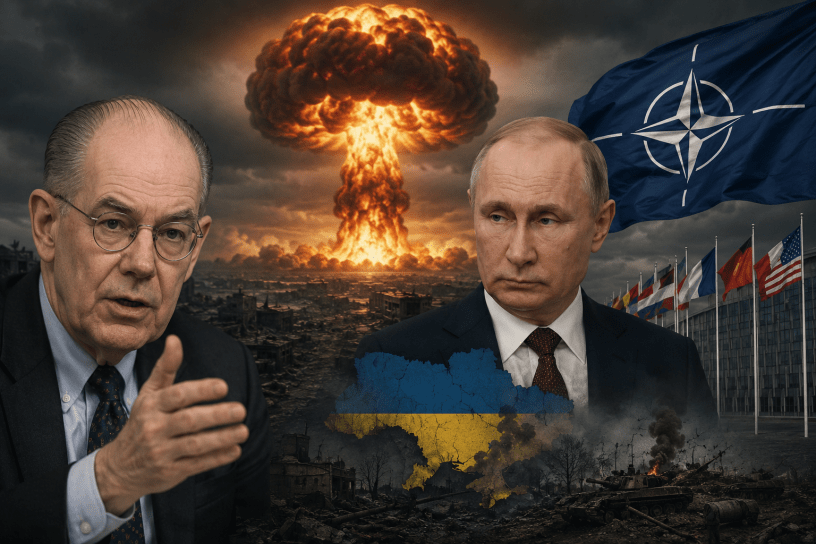
John Mearsheimer Interview by Daniel Davis, May 13, 2026.
See also: Putin reacts to Ukraine’s attack against a School dormitory in Donbass
Source: YouTube
Transcript: resistancenews.org
DAVIS: Russia is demanding that Ukraine leave the Donbas to have an open corridor, and then they will have peace talks. And that’s a little bit different because the Russians have been saying: “We won’t do any kind of a ceasefire until we have an end-of-war negotiations — we’ll talk every day but we won’t do a ceasefire.” Now they’re saying: “Look, if you guys leave the Donbas” — and apparently all four of the areas that the Russians annexed back in 2022 — “then we’ll have a ceasefire and a long-term negotiation,” because they think it’ll take a long time. But Zelensky says: “Yeah, that’s not a good idea. I’m not going to do that.” He’s actually been saying this for a while. You see, this is dated April 30th — he refuses any Russian demands to surrender anything, won’t go out of any territory.
Now, today — I think it was today — we had Peskov reissue that statement:
“President Zelensky must order the armed forces of Ukraine to cease fire and withdraw from the territory of Donbas, from the territory of Russia’s regions. At that moment, the ceasefire begins and the sides will be able to calmly engage in negotiations. By the way, they will inevitably be very difficult and will involve a large number of important details.”
Now, before I even get to the Ukraine side or to the European view on that part — what do you make of the fact that the Kremlin is saying: “Hey, we’ll do a ceasefire now, as long as it’s pretty significant submission on the Ukraine side — still a withdrawal from the Donbas area”? What do you make of this change?
MEARSHEIMER: Well, Danny, I think it’s very important to emphasize that he’s not simply calling for a withdrawal from the Donbass. He’s calling for a withdrawal from all Russian areas. And as you know, the Russians have annexed four different oblasts. Two of them are in the Donbass, and two of them are not. So, Peskov is asking that the Ukrainians abandon the territory they now control in all four oblasts. This includes Zaporizhzhia and Kherson. And I don’t think that’s going to happen.
But let’s assume that that does happen. I don’t find it surprising that the Russians would then be willing to accept a ceasefire. And I think for two reasons. One is that they would have achieved their principal goal of controlling all four of the oblasts — or controlling all of the territory in the four oblasts that they have annexed — which is what they have said has been their principal goal in this conflict for a long time, in terms of territory. Right? So they’d have that.
The second thing is: a ceasefire is just another word for a frozen conflict. And that’s what you’re going to get here. The idea that you’re going to get a ceasefire that’s going to then open up the road to negotiations and you’re going to get a peace agreement — that’s not going to happen. You’re never going to get a meaningful peace agreement. The best you can hope for is a frozen conflict. And what I’m telling you is that a ceasefire is effectively a frozen conflict.
So what I think the Russians — and here we’re talking about Peskov and Putin — are saying to the Ukrainians is: “Give us all that territory that we’ve annexed, a good chunk of which we — Ukrainians — now control. Just abandon it, and then we’ll have a ceasefire,” which will be the frozen conflict. And unsurprisingly, Zelensky said no thanks.
DAVIS: Now it’s interesting. There are two interpretations for why that — tactical, I guess “pause” is the right word — or at least the lack of any forward motion by the Russian side. I’m going to show you the two different sides here and we’ll see which you think is the more accurate.
First of all, by General Ben Hodges — he’s looking at it from the Ukraine side:
“It’s clear that the momentum has shifted somehow to the advantage of Ukraine. That doesn’t mean Ukraine’s about to win or something like that. But I think it’s become increasingly clear that there’s no way that Russia can actually defeat Ukraine. This momentum has shifted in part because of the enormous casualties that Ukraine has inflicted on Russia — casualties now, for the first time, exceed what Russia’s able to bring into the army. And so there’s no meaningful progress for months now on the ground by the Russian forces.”
Now, I’ll tell you, because of some conversations I’ve had here in Washington DC in just the last few days — that is a general consensus. Most people, even those in the restrainer camp, believe that Russia has lost their momentum and they haven’t conquered Ukraine. And like General Hodges said, they can’t — they haven’t — because they can’t do that.
So, before I tell you the other side of the view, what do you make of General Hodges and this prevailing view here in Washington?
MEARSHEIMER: Well, there’s hardly ever any facts that back up these claims. These are just assertions. And as we know, there’s a propaganda war that takes place in addition to the actual war on the battlefield. And what people like General Hodges want to do is they want to buck up the Ukrainians. They want to tell them that they can win. And furthermore, they want the West — both the United States and the Europeans — to continue supporting Ukraine. And the way you do that is you say Ukraine is prevailing on the battlefield. It is basically turning the tide and the Russians are in deep trouble. They’re running out of manpower. They’re suffering enormous casualties. And the war is Ukraine’s for the winning. That’s the basic story that’s told ad nauseam in the West, and that story has been an ongoing story for years. I mean, what General Hodges is now saying is a story we could have heard a year ago, two years ago, three years ago. The West constantly tells that story.
I follow the war reasonably closely and I don’t believe it. I think there’s no question that the Russians took a pause. And I think there’s no question that the Ukrainians recaptured a tiny bit of territory. But it’s meaningless in the overall scheme of things. And the Russians are now back on the march — it’s quite clear. And although they’re not gobbling up territory the way I think you and I thought they would two or three years ago — in large part because of the presence of massive numbers of drones — there’s no question that they’re moving forward. And I believe they will end up conquering the Donbass in the near future. I believe they’re not that far away from it.
And in terms of the casualty levels: I’d be willing to bet a lot of money that the casualty levels on the Ukrainian side are far above the casualty levels on the Russian side. We never hear anything about what Ukrainian casualties look like. Why is that the case? Why aren’t the Ukrainians — who can easily tell us what the numbers look like from their side — saying virtually nothing? I believe the reason they’re not telling anyone is that if we heard the actual figures they have, the real figures they have, we’d be horrified by the number of Ukrainians who have been killed.
But furthermore, let’s assume that the Russians capture very little additional territory and that we get a ceasefire at the end of this year. Let’s just assume that that happens. Who wins that war? It seems to me that the Russians win. They end up with 20% of Ukraine and they end up with a frozen conflict. So I think there’s no hope of Ukraine recapturing all that territory that it lost in the eastern fifth of its country. It’s just not going to happen. The Russians are going to keep the territory that they have now conquered in this hypothetical situation I’m describing.
So the only interesting question at this point in time is: how big a victory does Russia achieve? Does it conquer all of the territory in those four oblasts that it has annexed, or does it only conquer a portion of that territory? Or maybe it might conquer additional territory beyond the 4 oblasts. Who knows for sure how this is going to play itself out in the months ahead.
DAVIS: Well, and that’s where I wanted to go next. So that’s kind of the view from Washington, from Kiev, from the Western world — that this is something where we’re wearing Russia down, and the implication is that somehow we can get it back in the future. But there’s another interpretation of why we’ve been seeing the slowdown in the Russian forward momentum — and that is because Russia is preparing for something much, much bigger. And they have been stockpiling a lot of their weapons and ammunition for quite a long time now.
There have been reports — well over a year ago — that the industrial capacity, especially for the Gerans, the long-range drones, and many of its missiles like the Kinzhal and several other hypersonics, has been on something close to a full wartime footing. And it had been up, for the drones, around 800 to 1,000 a month a year ago. And yet, other than last night — last night there was another big one, one of the biggest pushes, I think 800 drones were used by the Russian side against Ukraine — but that’s less now. Apparently from the reports I saw this morning, it’s at 1,500 per month. But they’re not using a fraction of that on the front. So that implies that they have been building up a large stockpile.
And some are arguing that they’re getting ready for a summer offensive of a nature that has not been done at all in this war from the Russian side since the initial invasion in February 2022, and that they may now try to break through defensive lines and potentially capture more territory.
Now, I was already worried because of that. Earlier today, you sent me something from one of our friends, Glenn Diesen, who’s been on our show several times and is a really good podcaster and professor in Europe. He had a guest on — Mr. Karaganov here — who used to be an outlier on the Russian side about being very progressive, but now, according to this, he’s more in the mainstream, and his views today are very alarming:
“We have restored our soul and our honor. We have started to value those people in our society which are truly valuable — meritocratic elites, scholars, doctors, officers. So the country is becoming more healthy. But for that we are paying with too many bodies. So my advice to my government is that we should stop this war — at least in Europe — by going up the ladder of escalation: first attacking with conventional weapons, symbolic or logistical points on European soil. We don’t need an inch of Europe, as you might understand. And then if they do not succumb, we should follow with nuclear strikes — relatively massive — of course offering some kind of ultimatum. If they do not succumb, some of the countries of Europe should perish.” [interview on May 10, 2026]
And I was shocked — and Glenn Diesen was just listening to that like he was hearing about some baseball score from last night. But here’s Karaganov talking about: well, we should now launch missiles to strike symbolic or military targets in NATO countries, and then if they don’t succumb, ratchet up to — he said — massive nuclear strikes. And apparently his claim is that that’s becoming now the mainstream view instead of a fringe view inside Russia.
Do you think there’s any truth to that? And is it even possible that Russia could — not as a response but as a proactive measure — use nuclear weapons?
MEARSHEIMER: Yeah. Just very importantly, Sergey Karaganov has been making this argument since early in the Russia-Ukraine war, and he was clearly in the minority in the early years of the war. But as he makes clear in that interview with Glenn, his view on the need to think about attacking targets in Europe and possibly using nuclear weapons against European countries is the majority view — in his opinion — inside of Russia, which is really quite shocking.
Now let me tell you what I think is going on here. I think that Karaganov and a lot of other Russians understand that the Europeans — and the United States — but they mainly focus on the Europeans. It’s very important to understand that they, in a very important way, detach the United States from Europe and focus on the Europeans as the bad guys. The argument is that the Europeans are using Ukraine as a battering ram against Russia. They’re providing Ukraine with all sorts of weaponry, especially drones, and they’re providing Ukraine with intelligence that allows them — number one — to stymie the Russians on the battlefield or to make it very costly to win battles. And number two, the Europeans are helping the Ukrainians to attack targets inside of Russia.
And in fact, if you look at what’s happening, according to the Karaganov view, the Russians are suffering greater and greater casualties because the Europeans are giving the Ukrainians more and more assistance — they’re giving them better intelligence, they’re giving them better drones and so forth and so on. And the argument is that the Russians just can’t allow this to continue. They can’t allow the Europeans to get off scot-free while the Ukrainians do the Europeans’ dirty work.
So the Karaganov argument is that what we have to do is we have to send a very clear signal to the Europeans that this has to cease — that they cannot continue to use Ukraine as a battering ram against Russia. If these Europeans think that they can allow the Ukrainians to knock Russia out of the ranks of the great powers with this strategy, they’re delusional. We’re not going to let this happen. That’s the argument.
So anyway, what Karaganov says should first be done is that countries in Europe that support the Ukrainians should be struck with conventional weapons. And of course, as you know, Danny, this means attacking countries that are in NATO. And Karaganov’s argument — and again, he emphasizes that many people inside of Russia basically agree with him — is: they believe that if the conventional weapons don’t do the trick, then a limited use of nuclear weapons is called for.
In other words, they’re not calling for a splendid first strike where you knock out Britain or France’s nuclear arsenal, or winning a nuclear war. They’re talking about a limited use of nuclear weapons, largely for demonstrative purposes, to send a very clear signal to the West that the Russians are not going to tolerate any more European support for the Ukrainian war effort. It has to stop. Period. End of story.
DAVIS: Yeah. It’s — let’s take a look at some of the media. That’s Karaganov, right? So, who was viewed as having an extremist view, but now it’s moving into the mainstream. Here’s just a couple of things from today’s news in Russia. Number one: “Great powers are coming into play — an unexpected direction of clash between the Russian Federation and NATO.” You specified Europe is named there. You look down and some of the same: “Romania should prepare in advance for a military confrontation between NATO and Russia, concentrating its efforts on the defense of the so-called Focșani Corridor.” This warning was made by the former deputy commander of NATO forces in Europe, James Everett. That’s one here.
And then let’s look at some of the others on the Russian side — from RIA Novosti, which is also out today. And they say: “Moscow allowed the West to prepare a bloody staging in Ukraine.” And when you go up into the details: “Moscow does not rule out the preparation of a bloody staging in Ukraine by the West.” And then it continues on to talk about how they’re potentially going to get ready to do more things there.
So basically there’s more and more public discussion that the war may advance. And I can also tell you, from a number of sources inside of Russia, there has been a lot of complaints. Some people have contacted me directly from Moscow who have friends and family members on the front lines, and they say that there has been growing anger at Putin for not doing these things — because they say: “They’re basically holding us back on a leash, allowing us to do this inch-by-inch thing and not letting us go forward. Where’s the plan here?” So they have been pushing Putin from a lot of angles. And another source I had said that even some of the higher-ups at the Politburo level have been pushing Putin, and he’s under pressure to do something more. Are you concerned about that pressure?
MEARSHEIMER: Oh, for sure, for sure. And this pressure has been on Putin for quite a while now — we’ve talked about it before. But I want to make two what I think are very important points.
Number one is that as Trump goes to great lengths to eviscerate the transatlantic relationship and as he moves away from NATO, this creates a situation where the Europeans are to some extent on their own. So in a very important way, Trump is playing into the hands of the Russians here, because American security is no longer tied as tightly to European security as it was under Trump’s predecessors. So you just want to keep that in mind — as the transatlantic relationship frays, it makes it more likely that the Russians would do this.
Second point I would make: you want to remember that in the course of the war in Ukraine, the West has supported a Ukrainian invasion into mother Russia — the Kursk offensive in the late summer of 2024. In other words, the Ukrainians, with support from the United States and from Britain, invaded mother Russia. This was unthinkable during the Cold War. Unthinkable.
Furthermore, as you well know, the Ukrainians, with assistance from the United States and from Britain, struck at one leg of Russia’s strategic nuclear triad. They struck at the bomber force, which is one of the three legs of Russia’s nuclear triad. Again, this was unthinkable during the Cold War.
And Karaganov is saying — and I think he’s quite correct here — that people in the West have lost sight of the fact that we live in a nuclear world and that Russia is a nuclear-armed power, and you just can’t do anything you want to Russia and get away with it. And Karaganov’s point is that Putin and others have failed to send that message to the West loudly and clearly. And as a result, the West — and here he’s talking mainly about the Europeans today, as I said before — the West just thinks it can slap the Russians around and get away with it.
And I actually think in that sense, Karaganov is right. I’m actually quite surprised at the extent to which the Western elites don’t understand how dangerous a game they’re playing with regard to the Russians. They think that Russian red lines don’t mean anything. And Karaganov says this is true and we have to rectify the situation. And his basic argument is: there’s only one way you rectify this situation, and that is you pop off a few nuclear weapons, and that will focus their minds. They’ll come to realize that we live in a nuclear world and you have to behave differently in a nuclear world than you behave in a non-nuclear world.
So that, I think, is what’s going on here. And all of this tells you that if people like General Hodges are right and that we are now in a position where we can defeat the Russians, where the tide is being turned — they should understand that that greatly increases the chances that the Russians will turn to nuclear weapons.
DAVIS: And by the way, this is something that some of the others I’ve talked to have mentioned — many in Russia actually believe that last December there was an attack against Putin at his residence, an attempted assassination attempt by the Ukrainian side, while he was allegedly waiting for a phone call from President Trump. A lot of people in the West have cast doubt on that, but really the only thing that matters is what people in Russia believe. It almost doesn’t even matter what was actually true. But that apparently is one of the things on top of that list that has a lot of them animated in that direction.
I know you’re running out of time here, so last question for you, John. One of the things that worries me about whether or not Russia would think about doing what used to be the unthinkable — even at the conventional level of actually striking something on NATO territory of a military nature, which would definitely trigger an Article 5 — is part of their calculation that, you know, I can do math too, says the Russians, and I see all of these long-range missiles, all of these artillery rounds, all kinds of stuff — armored vehicles, thousands and thousands of them — you guys have sent into the graveyard in Ukraine, and knocked out your own, especially PAC-3 anti-aircraft missiles and air defense missiles of various kinds. You’ve dwindled your stockpile numbers down. The US has dwindled our numbers down, and now — as we talked about at the top of the show — we’ve even further drawn them down in Iran. Might Russia say: “Your ability to defend is a lot less than it used to be, and we on the other hand have been for years now, with our industrial capacity, building up inventories of everything” — and maybe that might cause them to take a risk they otherwise might not have?
MEARSHEIMER: Well, I don’t think that Karaganov and the Russians more generally are thinking in terms of winning the war by using conventional forces to strike into Western Europe or using nuclear weapons. I don’t think that’s what’s going on here.
What Karaganov is talking about is demonstrating to the West that you are willing to go up the escalation ladder, and that what you’re going to do is you’re going to put both sides in a situation — this is especially true if you use nuclear weapons — where the situation could spin out of control and we could all get incinerated. But we’re just sending you a message — you, the West — that the last clear chance to avoid disaster rests with you. And that means that you better cease and desist from thinking that you can supply Ukraine with weapons that will allow them to defeat us on the battlefield. So it’s more demonstrative in purpose than it is for winning the war. That’s not what they’re thinking about here.
It’s the way, by the way, that we thought about using nuclear weapons during the Cold War. If the Warsaw Pact attacked in West Germany and was overrunning West Germany, we didn’t think about using nuclear weapons as a way of winning the war. What we thought we would do was use nuclear weapons to demonstrate to the Warsaw Pact — or in this case the Soviet Union — that we were deadly serious and that they better stop the war right away before we went up the escalation ladder. So it was that demonstrative effect that we’re talking about, and I think that’s what Karaganov is talking about.
Although Karaganov does say that if the demonstrative use of nuclear weapons doesn’t work, then we go up the escalation ladder. And I think he believes that at some point the West will back off, because nobody wants to get incinerated. That’s the basic logic here. Once somebody uses nuclear weapons, Karaganov would say, once those things are used, everybody will understand just how dangerous the situation is and everybody will back off, right? Enough is enough. We don’t want to be incinerated. So the Russians just have to use a few nuclear weapons to get us in that position. That’s the logic here. I mean, I hope to God that that doesn’t happen — and I want to be very clear on that — but I’m trying to explain as clearly as possible what’s going on here.
DAVIS: Now, I’ve seen in additional reporting that some in Russia would say that before they hit the demonstration level of nuclear — tactical nuclear weapons — they would strike conventional missiles at several military targets inside a number of NATO countries, as a pre-step to saying: “We’re willing to go up the escalation ladder and the next one is nuclear weapons.” So my question for you is: given what you know right now, especially with the hubris on the Western side, if conventional missiles land on NATO territories — and of course they’ll immediately invoke Article 5 — are they going to get that message? Or do you think we’re going to ignore that and go up the escalation ladder ourselves, hit back at Russia, triggering potential nuclear war?
MEARSHEIMER: Well, the thing is that if the Russians were to launch a demonstrative conventional attack into, let’s say, both Poland and Romania, there’s no question that it would be clear that the next step up that ladder would be using nuclear weapons. There’s enough public discourse on this, and the Russians would make that clear. The Russians, if they were smart, would say: “This is the first step. It’s not nuclear. But you want to understand that if this doesn’t work, we’ll go up the nuclear ladder.” So we’d understand that.
So then the question is: what do we do? What would you do? What would I do? We get hit with conventional weapons. We all understand the importance of an Article 5 guarantee. But at the same time, Danny, we understand that if we retaliate against Russia with conventional weapons — we decide that we’re going to play tit-for-tat with them — that means in all likelihood that they will then turn to use nuclear weapons. And when they use nuclear weapons, what do we then do? Let’s assume that they used six nuclear weapons. Would we then take six nuclear weapons and lob them back at Russia?
You know, it’s the road you don’t want to go down. And I think any time nuclear weapons are used, the incentives for everybody to just put a damper on things and step back and put an end to this before it spins out of control — the incentives to do that are just enormous. And of course the Russians understand this. This is the logic that underpins Karaganov’s position, right? That if they use nuclear weapons first, it’s not like we’re going to have any incentive to use nuclear weapons second — we’re going to say: “Let’s end this one.”
And again, you want to remember: the Americans are trying to pull away from Europe as much as possible. So the Americans are not going to want to get involved in a nuclear war with Russia, or even get involved in a conventional war involving Ukraine. So the Russians, you know, have a pretty strong hand to play here — which is what makes this, by the way, scary.
DAVIS: Well, it certainly has me — and the scary part is the logic underneath it. Take the morality out of it, take the “what should or shouldn’t happen” out of it. But the fact that they have these cards to play, and if they have the will to use them — and to forgive the pun, play Russian roulette and say: “I’m willing to go — are you going to take the next round?” I just — I worry. Tell me if you think this is misplaced or not. I worry that there are too many hotheads in the West that would say: “How dare they. There’s no way we’re going to back down now. We’re not going to let those Russians get away with this. We are going to retaliate.” And when they say “we,” that really means France, the UK, or the United States, because that’s the only ones that have those kind of cards to play. But do you think anybody else would fire off conventional missiles — whatever the targets were — that could then make them the target of return fire?
MEARSHEIMER: I mean, who knows for sure. My guess is that there will be very few people in the West who will want to go up the escalation ladder — who will say: “Let’s pull out a few nuclear weapons and now hit mother Russia in return.” I think the threat of nuclear escalation, which could end in annihilation for all of us, is powerful enough to cause almost all serious people to think about how to defuse the situation, not escalate it.
The problem that you face here, Danny, if you’re playing the Western hand, is that there’s no way you can win by escalating. I mean, it’s not like you can use Western nuclear weapons to go up the escalation ladder and achieve a victory in a nuclear war.
DAVIS: It’s very important to understand.
MEARSHEIMER: Yeah. And just to unpack this just a bit more — the Russians, as I said to you, and we don’t want to lose sight of this: the Russians are not using these nuclear weapons to win the war. That’s what I said before. They use them for demonstrative purposes. To put it in Thomas Schelling’s famous rhetoric: what you want to do is you want to throw both sides out on the slippery slope. Right? That’s what’s happening here. When you have a limited use of nuclear weapons, you’re in effect throwing both sides out on the slippery slope. And you’re saying in effect: “We don’t really know very well what the dynamics of escalation look like.” And it is important to emphasize that we have thankfully never had a war involving nuclear weapons between two states that both have nuclear weapons of their own. So we don’t know much about the dynamics of escalation here. And it could all end horribly.
And the last clear chance to avoid disaster rests with you — the Europeans, or you — the Americans. And therefore you better not go up the escalation ladder. And we then decide that we have to reach some sort of deal with the Russians about how to end the war in Ukraine. And if that happens, then Russia wins. It wins in the sense that it coerces. It doesn’t win a military victory on the battlefield — doesn’t achieve a splendid first strike with its nuclear arsenal. But what it does is: with these demonstrative strikes, it coerces the Europeans and the Ukrainians and the United States into stopping the attacks against Russia and working out some sort of deal.
And again, Karaganov’s point is that if you look at how the West has treated escalation against Russia since this war started in February 2022, it’s quite remarkable how little they care about our red lines. They think they can do things to us that neither side dreamed of doing to the other side in the Cold War. And as I said to you — not to beat a dead horse — as someone who grew up in the Cold War and paid an enormous amount of attention to these issues, I — like Karaganov — am quite shocked at how cavalier so many people in the West are about: number one, striking targets inside of mother Russia; and number two, just talking about knocking Russia out of the ranks of the great powers.
All sorts of people have been talking about that since the very beginning. I think that was the Biden administration’s principal goal when the war started. I think General Austin — of course he was then Secretary of Defense — made this point clear: we wanted to knock the Russians out of the ranks of the great powers, and we wanted to do it with sanctions but also with the Ukrainians on the battlefield. And I said to myself at the time: you really want to think about this. This is a nuclear-armed country that cares about its survival and you’re talking about knocking it out of the ranks of the great powers, and you don’t think that that might end up with a nuclear war? I don’t know, but people were very cavalier. Again, that’s Karaganov’s point.
DAVIS: And they seem to still be that way. Do you have time for one more question, or do you need to go? I know we’re already over time.
MEARSHEIMER: Yeah, I have time for one more question.
DAVIS: Okay. We’ve been talking theory here, but let’s see if this actually came into play and they did fire off this limited number — and let’s just hope and say it was only three, maybe even only one, someplace. What happens on the physical territory wherever they might launch one — we’d presume a tactical nuclear weapon with limited explosive power — but what would happen on the ground were that to happen, and what would be the mentality of whatever country that was? How would they recover from that?
MEARSHEIMER: Well, it’s hard to say exactly what the Russians would do if they were pushed to use nuclear weapons — just like it was difficult to say what we would do during the Cold War if the Warsaw Pact were overrunning West Germany and we decided that we were going to employ nuclear weapons. How many do you use? And where do you aim them? What do you aim them at?
My guess is that what you try to do is you try to minimize the casualties as much as possible. You don’t use a very large nuclear weapon or a large number of nuclear weapons — maybe a few nuclear weapons, not terribly large yields — and then you target areas where there are not many people. And what you bank on in that circumstance is: you bank on the fact that the mere use of nuclear weapons is enough to scare the living be Jesus out of everybody.
DAVIS: Well, it should.
MEARSHEIMER: Yeah. That — well, I believe that it would. Again, this is Karaganov’s argument, and as scary as it is, there is a powerful logic behind it. But it’s the mere fact that nuclear weapons have been used, and that the Russians have demonstrated that they’re willing to use nuclear weapons because they think their survival is being threatened — that is all that is necessary. That would be the logic of the story I am telling: that you don’t have to hit a major town or a major city with a large number of nuclear weapons. You just have to use these things. That by itself is enough to reestablish deterrence, so to speak.
DAVIS: Do you think that Karaganov’s comment on Glenn Diesen’s show was just him on his own, or do you think that it was with the knowledge of the Kremlin?
MEARSHEIMER: I don’t think it was with the knowledge of the Kremlin. I think Karaganov is a big-time strategist. He’s been around. He’s my vintage — I knew him during the Cold War. And he is very influential and he pretty much speaks his mind. He’s the sort of person who I am sure tells Putin that he disagrees with him, if he does disagree with him. He is not somebody who pulls his punches, and I would imagine that Putin appreciates the fact that he’s so honest. But I’d be very surprised if he got permission. And the main reason I say this, Danny, is that he’s been making this argument for a long time. As he told Glenn Diesen, he was in the minority to begin with — most people thought that he was wrong, that it was just a bad idea. I would imagine most Russians were shocked by the idea at first.
But what’s happened with the passage of time is that more and more people now buy his argument. And one could argue that from Putin’s point of view, or from the point of view of the Russian elite, it’s a good thing for Karaganov to go on shows like Glenn’s show and say what he did, loudly and clearly — because it sends a signal to the West that the Russians are thinking about going down this road.
And by the way, one very important element in this story, which I have not emphasized but which you did emphasize quite correctly, is that Putin has been under a lot of pressure for a long period of time to play hardball with the West. Many people inside of Russia think that he has waged this war as if he were a pussycat and he has not been tough enough with the West. And one can imagine that that message has gotten through to Putin, and there’s a lot of pressure on him — now, from outside and even from inside his own head — telling him that he has to get tough. And if that is true — and I would imagine it is true — Karaganov’s message would be a powerful message to him.
DAVIS: We just have to hope and pray that something changes, especially on the Western side, because God help us if we remain foolhardy and don’t do anything to change the dynamics, or think that we can press harder and somehow come out with a better outcome. It seems likely to backfire in a way that we can’t even comprehend.
Thank you so much for coming on today, and thank you for giving us a little bit of extra time here. I know we went over, but very, very grateful for that. Send people to Mearsheimer.substack.com so you can keep up with John in between the times he’s here, because he’s always got great stuff to say — like he did today. Kind of shocking, but it’s the truth, and it’s stuff that we need to be aware of before it gets into crisis mode. So thank you for coming on, then. Thank you, guys, too, and we will see you on the next episode of the Daniel Davis Deep Dive.
To support our work, you can donate, share this article and subscribe to our newsletter.
 Resistance News Unfiltered