
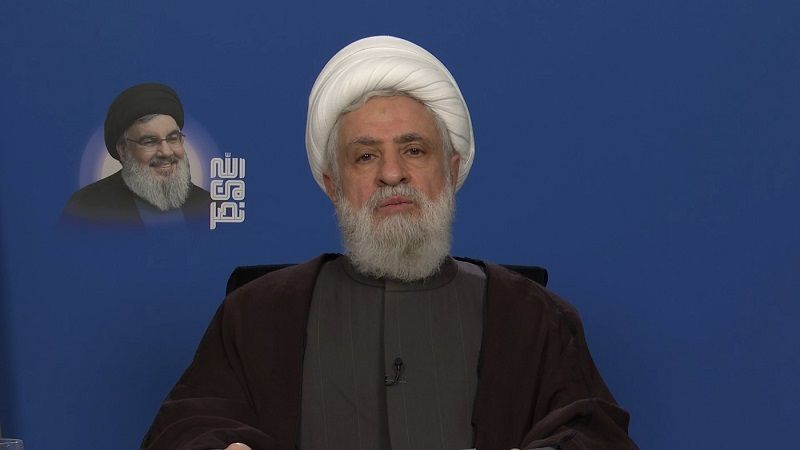
Speech by Hezbollah Secretary General Sheikh Naïm Qassem on the latest developments, 27 January 2025.
1. Gaza’s victory
2. Narrative and Reckoning: What Happened to Hezbollah?
3. Honesty about Hezbollah’s setbacks
4. The ceasefire
5. The Return Scene and Israeli violations
6. Campaign to Discredit Hezbollah
7. What next?
8. The Presidency and Government
Source: Youtube
Translation: Resistance News
1. Gaza’s victory
[…] Third Point: We must extend our congratulations to the steadfast Palestinian people and their Resistance in Gaza, the West Bank, and the 1948 territories on achieving the ceasefire. Likewise, we must congratulate the partners in victory, foremost among them the Islamic Republic of Iran under the leadership of Imam Khamenei, for their unwavering support to this people and their Resistance.
Our gratitude also goes to dear Yemen, which has given and sacrificed and continues to do so; to dear Iraq, with its people, its religious authority, and its mobilization; and to Lebanon, which made courageous and significant contributions—sacrifices of blood and valor—including the Master of the (islamic) Nation’s martyrs, Sayyed Hassan Nasrallah (may God have mercy on him), in the effort to support Gaza.
This victory belongs to the Palestinian people, to all the peoples of the region who have stood firm and struggled, and to all the free people of the world who have supported and defended the cause. The objective of Operation Al-Aqsa Flood has been realized: restoring the Palestinian cause to the forefront of global discourse, even in the West, where its legitimacy and persistence have been affirmed. Today, the release of prisoners stands as a genuine triumph for the Palestinian people.
Israel has failed the test of honor and humanity. Its attempt to destroy Hamas and the Resistance has been decisively defeated. Instead, Israel has exposed itself as a belligerent criminal entity bent on extermination. It failed to retrieve its captives except through negotiation, and clearly displayed its profound weakness, because it would not have withstood a single week without the unreserved US support it received by air, sea, and land, with all the possible resources.
The Palestinian people are worthy of life and liberation, and, God willing, they will achieve the complete freedom of their land, from the river to the sea. The resounding march from southern Gaza to its north is a powerful expression of popular liberation—an uprising of a great people who have given so much.
Congratulations on the release of the prisoners in large numbers and heads high. Salutations to the martyrs and to the resilient wounded—men, women, and children. Honor and greetings to all.
2. Narrative and Reckoning: What Happened to Hezbollah?
I now go to the most important part of my speech, which I have titled “Narrative and Reckoning.” This review covers six key points: what we faced, honesty with the people, the ceasefire, confronting the campaign waged against us, what follows after the Israeli withdrawal deadline expires, and discussions on the presidency and government.
What did we face? The aggression against Lebanon, like that against Gaza, was backed by the United States and the Western world—forces that disregard laws, violate sanctities, and indiscriminately kill people while destroying stone, trees, and life itself without restraint. The disparity between the vast Israeli-American military power and the capabilities of the Resistance remains immense, regardless of how much the Resistance has accumulated in strength. Let us be clear and admit the reality: there exists an exceptional Israeli-American military superiority over the Resistance’s available military resources.
However, Resistance is not merely a military choice; it is an ideological, political, national, and humanitarian commitment to confronting occupation, its ambitions, and to liberating occupied land. Moreover, there is a stark contrast between the legitimacy and strength of the Resistance’s sacred cause and the falsehood and illegitimacy of occupation and aggression. Ultimately, truth prevails over falsehood because it is inherently stronger and more deeply rooted.
Thus, we are faced with two contrasting realities:
- Israeli military superiority.
- The superiority of the Resistance’s righteousness and will over the falsehood of occupation.
We are stronger in our faith, our cause, and our rights than they are in their occupation and aggression. It is a mistake to focus solely on military comparisons; rather, we must emphasize the power of faith, commitment, will, resistance, confrontation, sacrifice, and the ability to endure hardships in the face of Israel. Mark this victory down!
Israel and the United States sought to eliminate the Resistance. Israel launched its campaign with five military divisions—75,000 soldiers and officers—wielding brutal force and criminality to achieve this goal. But the Resistance stood its ground!
Every faction of the Resistance —Hezbollah, Amal, the Islamic Group in Lebanon, the Syrian Social Nationalist Party and all the other fighters from the movements who took part— confronted the enemy with legendary resilience, exceptional bravery, and a Hussaini spirit of martyrdom that proved itself on the battlefield, as everyone could see. On the battlefield, the heroic fighters of the Resistance gave their very skulls to God Almighty. Our people endured great sacrifices, and martyrs rose—foremost among them, the leader of the Resistance’s martyrs and the (Islamic) Nation, Sayyed Hassan Nasrallah (may God have mercy on him).
The Resistance proved itself cohesive and powerful, regaining command and control while filling the leadership vacuum within just ten days of the shockwave caused by Israeli strikes: we elected a new Secretary General and filled all the positions, without exception. From September 27 to October 7, we endured the most difficult days, as Israel executed a well-planned strategy aimed at delivering a fatal blow to Hezbollah. But through faith and the choice of Resistance, we reclaimed our strength with this momentum that the Master of Martyrs (Sayyed Nasrallah) has granted us.
The Almighty said:
“Or do ye think that ye shall enter the Garden (of bliss) without such (trials) as came to those who passed away before you? They encountered suffering and adversity, and were so shaken in spirit that even the Messenger and those of faith who were with him cried: ‘When (will come) the help of God?’ Ah! Verily, the help of God is (always) near!” (Quran, 2:214)
Mark this victory down!
Resistance operations escalated, and the Israelis advanced no more than a few hundred meters along the front—thanks to the legendary steadfastness of the mujahideen.
Our displaced people stood firm, placing their trust in God and providing vital support to the frontlines. The fighters took solace in their families, just as the families found reassurance in the Resistance’s steadfastness on the battlefield. The Lebanese people, across all sects and regions, remained loyal and present.
The Lebanese Army made sacrifices; civil defense teams and health organizations played their roles courageously; and the media played a crucial role in conveying the truth. We must also acknowledge the unwavering support of the Islamic Republic of Iran and the backing of both the Iranian and Iraqi peoples, in addition to aid from other allies.
What was the outcome?
- The Israeli enemy failed to achieve its objectives—it could not advance on the front.
- It failed to ignite sectarian strife within Lebanon.
- It was unable to dismantle the Resistance, which remained strong on the ground.
- The Israeli army suffered heavy losses, and the Zionist entity faced setbacks on all fronts—security, economic, social, political, and psychological.
Faced with attrition and a prolonged stalemate, Israel—through the United States—requested a ceasefire. We, alongside the Lebanese state, accepted the ceasefire. And this is another victory!
Mark this victory down!
3. Honesty about Hezbollah’s setbacks
Now, I move to the second point of my speech, which I have titled “Honesty.” This frankness is necessary because the public has yet to hear the words I am about to say, nor have they heard our perspective on what has transpired.
This honesty is directed at the supporters of the Resistance. When I say “the supporters of the Resistance,” I mean:
- The immediate Resistance environment.
- Every individual in the Resistance, without exception.
- All who support and uphold the Resistance—whether in Lebanon, the region, or worldwide.
The Resistance is not merely a group of individuals or a party; it is a vast movement—men and women, young and old—advancing on all fronts.
The immediate environment of the Resistance is steadfast and enduring, and I have full confidence in it. It is composed of the masses shaped by Husseinite teachings, who give and sacrifice without hesitation; the followers of Imam Khomeini, may God sanctify his noble soul, who toppled the Shah and shook the region and the world with the victory of the blessed Islamic Revolution in Iran; the disciples of Imam Musa al-Sadr, who paved the way for the Resistance; and the supporters of Sayed Hassan Nasrallah, may God the Most High be pleased with him, who has entered hearts, homes, and every sphere, unhindered. Yet, some among the Resistance’s supporters are questioning and expressing astonishment at what has transpired—and rightly so. What happened was momentous, the war was immense, and some of its outcomes were unforeseen. It is only natural that such questions should arise. Let me provide you with a clear answer to these questions.
First, due to the military capabilities accumulated by the Resistance, including missiles, rockets, and drones, as well as maneuvers that demonstrated exceptional strength on our part, many believed that we would defeat Israel with a decisive blow if a confrontation arose between us. They assumed that our strength was sufficient to defeat Israel militarily. This (false) belief was widespread.
Second, the deterrent capabilities we built over 17 years created an expectation that Israel would not dare take major action for fear of our retaliation. This led people to believe that our military strength was enough to establish a permanent and formidable deterrent.
Third, our past victories—the Liberation of 2000, the July 2006 war, and the defeat of Daesh and the takfiris in 2017—gave the impression that we were always victorious militarily due to our superiority.
Fourth, our supporters did not anticipate the loss of so many leaders—chief among them Sayed Hassan Nasrallah, the Master of the Martyrs of the Resistance, may God be pleased with him—in such a short time. This was unexpected given our military capabilities, our vast organization, and our security resources. Was it reasonable to expect such swift and devastating losses in our ranks? Our supporters did not foresee this. We ourselves did not anticipate such a scale of losses among our leaders.
Fifth, there is no doubt that intelligence failures, the enemy’s dominance in communications and artificial intelligence, and the Israeli air force’s complete coverage of Lebanon all played major roles in the severe blows dealt to the Resistance. This was a significant vulnerability: we were highly exposed in all of these areas. We are currently conducting an investigation to draw lessons and take the necessary measures. What happened was extraordinary and unexpected, and we must understand every detail. This vulnerability should not have been there, but it was.
What is crucial to remember is that the Resistance cannot be the strongest militarily, and we must not define its superiority in military terms. Under no circumstances. The Resistance triumphed over Israel through its faith, its youth, its women, its children, its elders, its sacrifices, the blood of its leaders, and the price it continues to pay. This is how the Resistance wins. The military aspect is only one of the tools of victory. The Resistance derives its strength from its decisions, its will, and the belief of its followers. It is strongest in its steadfastness and its ability to endure immense sacrifices. It is strongest because of its unwavering continuity.
In this battle, we have achieved two great rewards: martyrdom and victory. Leaders, loved ones, fighters, women, children, and men have fallen as martyrs, and at the same time, those who remained on the ground have emerged victorious—because the Resistance endures. This victory is the result of our perseverance and resilience.
Take note of this victory!
4. The ceasefire
We accepted the ceasefire because we were the ones attacked, and it was the aggressor who requested to halt its assault under conditions. We agreed to stop the aggression because we never sought it in the first place, nor did we choose war to begin with. Therefore, it was only natural to accept the ceasefire, regardless of certain specific conditions.
Secondly, we agreed to the ceasefire because the State made the decision to take action to protect the border and expel Israel. This was an opportunity for the State to fulfill its duties and test its political capability. We agreed because the aggression initially targeted Hezbollah but soon escalated to all of Lebanon. It is the responsibility of Lebanon—its army, its people, its Resistance, its State, and all its political forces—to drive out the occupier and safeguard national sovereignty. This duty belongs to everyone.
With the agreement, we entered a new phase. As Hezbollah and the Islamic Resistance, along with all the fighters standing with us, we fully committed to upholding the ceasefire. Meanwhile, Israel violated the agreement approximately 1,350 times—by air, land, and sea—through bombings, attacks, home and infrastructure demolitions, and drone incursions.
We remained committed as Hezbollah, maintaining ongoing communication with the political authorities. At one stage, we contemplated responding to the attacks, but we were told: “If we retaliate twice, three times, or even four, it will be equated with the 1,350 violations—framing it as both sides breaking the agreement.” In other words, our response would have been portrayed as equivalent to their relentless breaches. It was better to exercise patience, despite the feeling of humiliation.
Israel acted out of spite, seeking revenge—bulldozing land, demolishing homes, uprooting crops. These actions had no military or security rationale; they were acts of vengeance for its defeat and losses, and an attempt to project an image of strength to its settlers.
Regardless, we upheld our commitment, while Israel did not. We knew that the sixty days would pass, and with God’s help, we would endure as much as possible despite the losses. God willing, the situation will improve.
5. The Return Scene and Israeli violations
Praise be to God, the scene of return that took place under the agreement, on January 26 at 4 a.m., was magnificent. People did not wait a moment—we witnessed a flood of cars and people returning to the South, the Beirut suburbs, the Bekaa, and beyond. The celebrations of victory were immense. I even delayed my statement for two days and said, “Instead of announcing that victory has been achieved, let us witness the people’s declaration of this victory.”
Yes, we were victorious—because we returned, because we reclaimed our land, and because the occupier was stopped in his tracks and will ultimately be forced to withdraw, against his will, due to our resilience and the sacrifices of the Resistance and the people.
Victory celebrations spread across all regions—it was evident. The fighters on the ground never wavered for a single moment, their heads held high, their determination unshaken. Mark this victory down!
The ongoing Israeli violations were painful, yet we chose to exercise patience and allow the State to bear its responsibility. Unfortunately, the American guarantor of the agreement is the very same patron and enabler of Israeli crimes. It did not play any deterrent role—instead, it facilitated and justified Israel’s actions.
We urged the State to apply pressure, and it acted at every level, but the US remains both the guardian and the thief—a proverb that applies to it 100%. Still, we did not provide any pretext for escalation, recognizing that the State alone must take the lead in managing this period and confronting Israel.
Many who call themselves “sovereignists” remained silent about Israel’s violations. For sixty days, we heard no criticism of these breaches, despite how quick they are to raise their voices over anything that aligns with the US or with their anti-Resistance agenda. How strange! This is Lebanon—ours and theirs. Lebanon is a shared homeland for all. We have always said that even those who oppose us politically are still our partners in this nation. Yet, we heard nothing from them regarding Israel’s violations. They did not demand accountability from America, they did not raise their voices, and they did not assist the State in this matter. Why? They should have stood against these violations—they, too, bear responsibility. Instead, they do nothing but place obstacles in our path and spin narratives to serve their interests. They tell us: “You did not win!” Well, let them say what they will. We have won—whether they like it or not. And if they don’t like it, they can get lost! I won’t say more. Let them figure out how they want to deal with this reality: This victory, on the ground.
Anyway, the agreement was on the State’s track, and we were on the same wavelength. But here’s the big question: What did you do? What happened with the breach of the agreement only reaffirms Lebanon’s need for the Resistance. Now, some may argue that the Resistance used this as a pretext, but the reality is clear: When the Resistance was actively fighting, Israel did not dare to advance. But once an agreement was reached and political negotiations began, Israel started pushing into villages and acting as it pleased. So, was it diplomacy that kept Israel at bay, or was it the Resistance? This is undeniable proof that the Resistance is essential and remains the true force confronting the Israeli enemy.
6. Campaign to Discredit Hezbollah
Fourth, a campaign was waged against us, even in the midst of war. Most of it came from within, while some of it was external, all aimed at portraying us as defeated.
Tell me, what interest do you have in depicting victory as defeat? Why are you rushing to declare that Hezbollah and Amal cannot survive, that the Resistance’s capabilities are fading, and that it will ultimately lose everything? In the end, I am certain that many were left in shock—because none of their hopes materialized. They spared no media outlet, no platform, no analyst, no journalist—they all fixated on pushing the narrative of defeat.
They are constantly working to demoralize our people, our supporters. But I tell you: Their goal of breaking our spirit has failed—and will always fail. The Resistance, without question, has won. The Resistance is always victorious—through its martyrs, its sacrifices, its tangible triumphs, its continuity. The Resistance triumphed with its faith, and its unshakable will. It remains steadfast. It won by forcing a ceasefire, by holding its ground, by resisting. It won because the enemy failed to achieve its objectives. The Resistance triumphed with this noble and great people—who, at the very first moment of the ceasefire, at 4 a.m. on January 26, marched back into their front-line villages. The Resistance won again—yes, once again—when the people surged into these villages despite the continued Israeli presence, standing in direct confrontation with the occupation.
This is the same people who claimed victory on January 26, when we saw villages overflowing with their residents, with others returning to their land, standing unarmed yet defiant in the face of the occupier.
I am reminded of the sacred verse they carry as a banner: “Do not weaken, do not grieve—you are superior if you are believers.” (Quran, 3:139) Did you see the scene? Did you witness how the people marched in their own liberation procession? Did you see this noble, honorable, and steadfast people? Look at the woman in her cloak, standing fearlessly in front of tanks, machine guns, and soldiers. Look at the men, women, and youth, advancing with their children—unshaken by gunfire even at close range. You see them standing, proud, unyielding.
Life is in the hands of God Almighty, but dignity is the responsibility of man.
This people possesses dignity. And those who have dignity stand. Those who have dignity advance to the frontlines to confront Israel. Those who have dignity are not intimidated by their guns, by their policies, or by their US support. These people have honor and pride. They want their land, and that is why we saw them there, in Khiam, in Aytaroun, Ayta cha’b, in Yaroun, in Mays al-Jabal, Blida, Hula, Maroun al-Ras, Taybeh, Ramiya, Bani Hayan, Bint Jbeil, Qantara, and many other towns. Each of these towns has become a symbol of resistance, pride, popular defiance against Israel, and the march toward liberation.
Israel cannot maintain its occupation in the face of such a resilient, steadfast people. This people deserves life and the return of their land. They cannot be defeated, and their land cannot remain occupied—no matter how much Israel, the US or their allies conspire. No matter the threats, no matter the killings, Israel must leave our occupied land.
And here is the defining scene: The Lebanese army, alongside the Lebanese people, standing in an honorable and noble act of resistance at the Lebanese border, facing Israel. This is a moment of great dignity. We have always said: The Army, the People, and the Resistance. They used to ask, “Where is the army, the people, and the resistance?” Well, here they are—standing together. Their union makes Resistance. Resistance is not just those who take up arms. It is also the presence that stands firm against the Israeli enemy in every form, in every location. Resistance is born from this people, from these villages, from all of Lebanon. The Army, the People, and the Resistance—this trinity is what stopped Israel, what prevented it from reaching Beirut, what kept it from advancing beyond the Litani River. This is clear for all to see. This trinity is as obvious as the sun at noon. The problem isn’t with it—it’s with those who refuse to see it.
But even if they deny it, the sun will continue to shine, despite the bitterness of the haters. The Army, the People, and the Resistance—this is the battlefield, this is liberation, this is victory, this is the foundation of a strong nation. And, God willing, it will remain radiant.
7. What next?
Fifth, what happens when Israel’s withdrawal deadline expires?
Israel is obliged to withdraw due to the expiration of the sixty-day deadline. We will not accept any justification for an extension—not by a single moment, not by a single day. We will not tolerate any delay. We have received information that the Americans are reaching out to Lebanese officials, proposing to extend the agreement until February 28—meaning Israel would not withdraw until that date.
Lebanese officials said no. They responded, “Alright, we’ll do it on February 18.” Again, the answer was no. Then it was said, “We need five locations that are hills.” Still, the response was no.
We are certain that His Excellency, President Joseph Aoun, would never grant Israel a single gain. Look at how he stood firm when the people marched toward the south—how he instructed the army to stand with them, blessed them, and strengthened their resolve. Does the US really expect that someone in Lebanon would agree to extend Israel’s withdrawal period? That someone would, of their own will and decision, prolong the aggression? That is impossible. No one in Lebanon—neither President Nabih Berri nor Prime Minister Mikati—would accept even a moment’s extension. Israel must leave. That is its responsibility, and it is the responsibility of the international community. Even if they threaten, even if they intimidate—if they choose to remain occupiers, then they must bear the consequences.
Any repercussions of the delayed withdrawal fall on the United Nations, the United States, France, and the Israeli entity. It is their responsibility to pressure Israel. The French president’s stance was commendable when he urged Israel to abide by and implement the agreement, but the American position is disgraceful—it justifies the delay and seeks an extension. What exactly do they expect from us? Do they truly believe that anyone with dignity and pride would accept such a thing? Let them search for groups willing to walk their path—perhaps they will comply. But as for this proud, heroic, and brave people, they will never accept.
The continuation of occupation is an assault on Lebanese sovereignty, and it is everyone’s responsibility to confront this occupation—the government, the people, the Resistance, the parties, the communities, and all sects. No one can afford to remain on the sidelines. This is an occupation, not just a matter for the Resistance alone, but an occupation of Lebanese land. Yes, most of those who live here are Shia, but this land—10,452 square kilometers—is Lebanon’s, and it belongs to all Lebanese.
We call for vigilance. Today, some are asking: “What is Hezbollah’s position? What is the Resistance’s stance?” I have written just two lines that define our core position: “We are facing an occupation that continues its aggression and refuses to withdraw, and the Resistance has the right to act as it sees fit regarding the form, nature, and timing of the confrontation.” This is our message to all—let those who wish to understand, understand.
8. The Presidency and Government
During the war, I made two direct statements affirming that we stand under the framework of the Taif Agreement and the Constitution, and that we remain committed to electing a president on January 9. This was a direct response to those questioning Hezbollah’s role, as well as confirmation that, even while we fight Israel, we are fully engaged with domestic concerns.
The Shiite duo (Hezbollah & Amal) secured a consensus-driven presidential choice with the election of His Excellency President Joseph Aoun. Without their participation, there would have been no consensus, and the president would not have been elected on this date, nor in such a noble and exemplary manner that reflects national unity. We contribute when there is agreement. We contribute when there is unity. And we achieve. This is strength—not just strength for the national Shiite duo, but a rightful and commendable strength.
There was an attempt to complicate the presidential term by bringing in a prime minister under the guise that he would oppose us or create conflict with us. Indeed, there were two or three difficult and tense days, psychologically speaking. But we acted with wisdom—because we seek consensus, because we seek a stable country, because we seek a functioning government, because we seek a State that stands on its feet, because we seek national accord.
We cooperated with the prime minister-designate, and by God’s grace, our relations with him are progressing smoothly. Today, the obstacles are not with us—they lie with others. Those who, when appointing the president, claimed, “We don’t want ministers, we won’t interfere, we leave his hands untied,” are now the very ones demanding shares and positions. Each of them now seeks their portion, calculating and bargaining, yet none are satisfied.
The issue lies with them. I say to you: Between us, the prime minister, and the president, matters are running smoothly, thank God, with no obstacles.
Here are the Tasks of the New Government
- First and foremost, national unity. Unity must be established on a national scale, not just at the level of government formation. The president must adopt a formation method that takes into account both internal and external challenges.
- The Removal of Israel from Lebanon by All Means Necessary.
- Reconstruction: So far, the party has surveyed 270,000 housing units and has provided repair and shelter assistance to approximately 200,000 people. This is a major achievement, but we need more time. I ask the people for patience—the scale of this effort is immense, and what we have accomplished now far surpasses what we achieved in 2006. I extend my gratitude to the Reconstruction Committee, Jihad al-Binaa, the Waad Committee, and all those who have worked tirelessly in this effort. Their achievements are truly remarkable.
- Building Institutions for the National Revival and Rescue Project.
- Restoring Rights to Their Owners.
- Combating Corruption and Holding the Corrupt Accountable.
I ask Almighty God to grant us success in our endeavors. God’s peace and blessings be upon you.
To support our work, you can donate, share this article and subscribe to our newsletter.
 Resistance News Unfiltered