
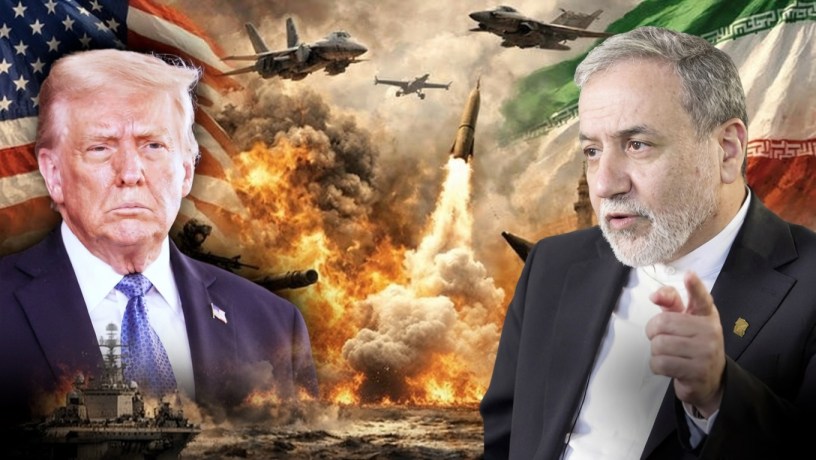
“Face the Nation” Interview with Iran’s Foreign Minister Abbas Araghchi, CBS, March 15, 2026.
Source: Youtube
Transrcript: Resistance News
Interviewer: We turn now to the foreign minister of Iran, Abbas Araghchi. Good evening to you, sir.
Abbas Araghchi: Good evening to you. Thank you for having me for the second time.
Interviewer: Yes, and they are extraordinary times. Minister, President Trump said this weekend he is not ready to make a deal with Iran because the terms are not good enough yet. His administration is saying this war could last another three and a half weeks or so. Has Iran asked for a ceasefire?
Abbas Araghchi: No, we never asked for a ceasefire, and we have never asked even for negotiation. We are ready to defend ourselves as long as it takes, and this is what we have done so far, and we will continue to do that until President Trump comes to the point that this is an illegal war with no victory. People are being killed only because President Trump wants to “have fun”. This is what he has said.
Interviewer: Have fun?
Abbas Araghchi: Yes, this is what he said, that they are sinking ships and targeting different places because it is “fun”. The Secretary of War has said that there is no mercy. This is actually a war crime. Even saying that is a war crime. So this is a war of choice by President Trump and the United States, and we are going to continue our self-defense.
Interviewer: Well, that may be your position, but sir, this is a war of survival for your government. Minister, don’t you have to negotiate and reach out either directly or through a third party?
Abbas Araghchi: No, it is not a war of survival. We are stable and strong enough. We are only defending our people from this act of aggression. We do not see any reason why we should talk with the Americans, because we were talking with them when they decided to attack us, and that was for the second time. There is no good experience talking with the Americans. We were talking. So why did they decide to attack us? What is the point if we go back to talk once again?
Interviewer: Well, I want to come back to that in just a moment. You are referring to the diplomacy with President Trump’s son-in-law Jared Kushner and his envoy Steve Witkoff. But just to continue on this: Iran is sending its drones and its missiles into your neighboring countries, American allies throughout the Gulf. Before the war, your government traded with them and had relations with them. If your government survives this conflict, how do you go back to doing business with countries you are sending drones into and hitting civilian targets?
Abbas Araghchi: Obviously these are the countries who have given their soil to American forces to attack us. What can we do? Should we just sit and watch while American forces attack us from their soil?
Interviewer: But your drones are going into civilian areas and hitting plants, hotels, and civilians.
Abbas Araghchi: No. This is not the case. We are only targeting American assets, American installations, American military bases. Everything belongs to the Americans. This is a fact: they are using their soil. There are many examples.
Just yesterday they attacked our islands using HIMARS artillery rockets, which are low-range rockets, and they used the territory of the UAE to attack us. A week ago, three F-15 jet fighters were shot down, apparently by “friendly fire”, in Kuwait. But nobody asked what they were doing in Kuwait. They were using Kuwait and the airspace of a neighborly, friendly country to attack us. So it is obvious we cannot simply remain passive.
Interviewer: Well, many of these countries are part of CENTCOM. But the point is that this is going to hurt your country in the long term. When we talk about the Strait of Hormuz, which is such an important transit point for global trade, you have said it is closed to Israel and to the United States. The Financial Times is reporting that European diplomats from France and Italy are talking to your government about trying to get safe passage for their ships. Are you open to restarting oil and gas vessels going through there?
Abbas Araghchi: We are open to countries who want to talk to us about the safe passage of their vessels.
Interviewer: Are you negotiating with France and Italy?
Abbas Araghchi: I cannot mention any country in particular, but we have been approached by a number of countries who want safe passage for their vessels. This is up to our military to decide, and they have already decided to allow a group of vessels belonging to different countries to pass safely and securely. We provide them security to pass because we have not closed the strait. They are not coming themselves because of the insecurity created by the aggression of the United States.
Interviewer: I want to ask you again about the negotiations. Iran has declared it has about 440 kilos of nuclear material. Where is that material now? Who has custody of it?
Abbas Araghchi: We have not declared it. This was verified and declared by the (IAEA) agency.
Interviewer: That is right.
Abbas Araghchi: This is not a secret. The agency has stated in many reports the exact amount of our enriched nuclear material.
Interviewer: Yes. So where is it now? Who has custody of it?
Abbas Araghchi: They are under the rubble. Our nuclear facilities were attacked and everything is under the rubble. Of course, there is the possibility to retrieve them, but under the supervision of the agency. If one day we come to the conclusion to do that, it would be under the supervision of the agency. But for the time being we have no program and no plan to recover them from under the rubble.
Interviewer: Am I understanding you here? I know that 48 hours before the US strikes you had personally offered President Trump’s negotiators to take that 440-kilo amount of 60% enriched material and dilute it. You said Iran was ready to give that material away. This was also in the deal presented to Vice President Vance by Oman. Today, is Iran still willing to give up that enriched uranium?
Abbas Araghchi: That was one of the elements of a deal we were negotiating with our American interlocutors. That element dealt with the question of Iran’s 60% enriched material. I offered that we were ready to dilute those enriched materials, or downblend them, as they say, into a lower percentage. That was a big offer, a big concession, in order to prove that Iran has never wanted nuclear weapons and would never want them.
Interviewer: Are you willing to give that up?
Abbas Araghchi: There is nothing on the table right now. Everything depends on the future. If at any time in the future we decide to enter negotiations with the United States or other interlocutors, we may decide what to put on the table. For the time being, nothing is on the table.
Interviewer: There are at least four Americans being held at Evin Prison that we know of, including the journalist Reza Valizadeh and Kamran Hekmati, a 61-year-old man. What is the status of those Americans? Are they safe?
Abbas Araghchi: If the United States and Israel do not attack our prisons, I guess they are safe.
Interviewer: Foreign Minister, we are running out of time and I can see the internet is going in and out here. I do want to point out that you are speaking to us via Zoom. The Iranian people do not have open internet access, but you do. Why?
Abbas Araghchi: Because I am the voice of the Iranians and I have to defend their rights. That is why I have access to the internet, to make sure our voice is heard by the international community. But the internet is closed for security reasons because we are under attack. We are under aggression and we have to do everything to protect our people. In any country, there are urgent measures taken for the sake of war.
Interviewer: Minister, I am glad the uplink worked so we could talk to you. We thank you for your time this morning.
***
MSNOW (former MSNBC) Interview with Iran’s Foreign Minister Abbas Araghchi, March 14, 2026.
Source: Youtube
Transrcript: Resistance News
Interviewer: Foreign Minister Araghchi, thank you so much for your time this morning, sir. I wanted to start with the news overnight that the United States has carried out a military strike on Harg Island. The President of the United States said:
“For reasons of decency, I have chosen not to wipe out all the oil infrastructure on the island. However, should Iran or anyone else do anything to interfere with the free and safe passage of ships through the Strait of Hormuz, I will immediately reconsider this decision.”
Let me start by asking you about what has happened on Kharg Island and what Iran’s response to these strikes will be.
Abbas Araghchi: Thank you so much for having me. I think our armed forces have already answered that they would retaliate if our oil and energy infrastructure are attacked, and they will attack any energy infrastructure in the region which belongs to an American company or in which an American company is a shareholder. So the reaction would be clear.
Last night they attacked Kharg Island and Abu Musa Island with the artillery rocket system known as HIMARS, which uses low-range rockets. They launched them from the soil of our neighbors. It is crystal clear that they are now using the territory of our neighbors to attack us with this kind of rocket, and this is absolutely unacceptable.
Interviewer: Which neighbors, sir?
Abbas Araghchi: Last night’s attacks were tracked by our forces. It is now clear that they were fired from the UAE, from two locations in the UAE: from Ras Al Khaimah and from a location very close to the city of Dubai. It is very dangerous that they use highly populated areas to launch rockets against us. We would certainly retaliate, but we try to be careful not to attack any populated areas.
Interviewer: Is there any sign that Iran is prepared to allow passage through the Strait of Hormuz? Will the Strait of Hormuz remain closed as long as this war continues?
Abbas Araghchi: As a matter of fact, the Strait of Hormuz is open. It is only closed to tankers and ships belonging to our enemies, to those who are attacking us and their allies. Others are free to pass.
Of course, many prefer not to because of their security concerns. This has nothing to do with us. At the same time, many tankers and ships are passing through the Strait of Hormuz, and I can say that the strait is not closed. It is only closed to American and Israeli ships and tankers, not to others.
Interviewer: We know that Iran has elected a new Supreme leader, Mujtaba Khamenei. He has not been seen yet in public, though he did issue a statement yesterday. I am sure you have heard the comments from the U.S. Secretary of Defense, Pete Hegseth, who claimed the Supreme leader is wounded and likely disfigured. What is the status of the Supreme leader, Mujtaba Khamenei?
Abbas Araghchi: They have made many claims like this. Yesterday they said that all Iranian authorities were in bunkers. But at the same time the whole world saw our president, the speaker of parliament, the secretary of our National Security Council, everybody in the streets among the people who demonstrated.
So there are many accusations like that. They will see soon that there is no problem with the new Supreme leader. He sent his message yesterday and he will perform his duties. He is performing his duties according to the Constitution and will continue to do that.
By now it should be clear to everyone that our system is very well rooted in society. The Islamic Republic is not dependent on any individual or group of people. It is a well-established political structure, and the state is doing its functions. Everything is functioning and everything is in place.
They should not have any hope that something happening to individuals would affect the system. The system is working. It worked properly after the assassination and martyrdom of our Supreme leader. Nothing happened and everything remained in order, and it is still under control.
Interviewer: I wanted to ask you about the war strategy from an Iranian perspective. There has been reporting that both Russia and China are providing targeting intelligence to Iran to strike U.S. positions, facilities, and infrastructure across the region. Can you confirm or deny whether Russia or China is providing military support and intelligence to Iran?
Abbas Araghchi: Russia and China are our strategic partners. We have had close cooperation in the past, and that cooperation continues. It includes military cooperation as well. I am not going into details about that, but we have good cooperation with these two countries politically, economically, and militarily.
Let me say once again that this is not our war. This is an imposed war against us. We did not start this war. It was an unprovoked, unwarranted, illegal act of aggression against us, and we are only defending ourselves. We will continue to defend ourselves as long as it takes in order to end this war in a way that ensures it will not be repeated in the future.
Interviewer: As you probably saw this week, the United Nations Security Council passed a resolution condemning your attacks on Arab neighbors. It received 130 co-sponsors, which is a significant number. Your close allies Russia and China did not veto that resolution. They abstained but allowed it to pass. Do you think the global community has spoken clearly about the way Iran has conducted this war on its Arab neighbors?
Abbas Araghchi: The Security Council is suffering from a lack of justice in its decisions and resolutions. How is it possible that the Security Council condemns us for defending ourselves and does not condemn the United States and Israel who started this aggression?
If they want to make a just decision or resolution that can work, they should consider all aspects of the situation. We are under attack. It was the United States and Israel who started this war. They deserve to be condemned, not us.
What we are doing is why many countries have become hopeless about the role of the Security Council, including the United States itself, which often acts independently. The council votes politically and based on the interests of certain countries, not based on realities or justice.
Interviewer: You do acknowledge, though, that Iran is targeting civilian targets across Gulf countries, right? Officials across the region say many targets hit are clearly civilian buildings. Why is Iran targeting civilian buildings, airports, and commercial ports in Gulf countries that say they are not involved in attacks against your country?
Abbas Araghchi: It is clear that we are attacked from their territories, from American bases and military installations located in Persian Gulf countries. This is very unfortunate. What we are doing in self-defense is targeting American bases, American installations, American assets, and American interests located in the territory of our neighbors.
For example, two days ago the United States attacked one of our banks. They are attacking our cities and civilian targets. They attacked a school in Minab. They have attacked hospitals. Two days ago they attacked a building belonging to a bank in Tehran. So we decided to retaliate in kind with buildings in two cities around us. What we are doing follows the principle of an eye for an eye.
Interviewer: Let me ask you quickly about the negotiations before the war started. Do you believe Steve Witkoff and Jared Kushner were good-faith negotiators conveying accurate information back to the White House about Iran’s position? There have been reports that you shouted at them and threatened that Iran had enough enriched uranium for 11 nuclear weapons. I want you to set the record straight about those negotiations in the final days before the war.
Abbas Araghchi: I do not know what they conveyed to their boss. What I know is that on 26 February, when we met in Geneva, we were able to make good progress. As the Omani foreign minister, the mediator, said, it was significant progress. Before he posted his message, he read it to both delegations and both delegations agreed that it accurately described what had happened: significant progress. This is what we achieved on 26 February.
The statements made by U.S. interlocutors are understandable. They are trying to justify an unjustified act of aggression. I never said that we were going to make bombs. I said that we have 440 kilos of 60 percent enriched material. That is not a secret. It is mentioned in IAEA reports. I said that if it were enriched further it could be enough for ten bombs, according to their own experts. But we were ready to give it up, to dilute it, to downblend it into lower levels. By saying that, I wanted to show that the concession we were making was very significant. How they interpreted that, I do not know. Maybe because of a lack of knowledge, maybe because they wanted to justify the act of aggression, which cannot be justified.
I hope the true story of what happened on 26 February in Geneva will become known soon.
Interviewer: Foreign Minister, thank you so much for your time. We are out of time, but we appreciate you joining us.
Abbas Araghchi: Thank you.
To support our work, you can donate, share this article and subscribe to our newsletter.
 Resistance News Unfiltered