
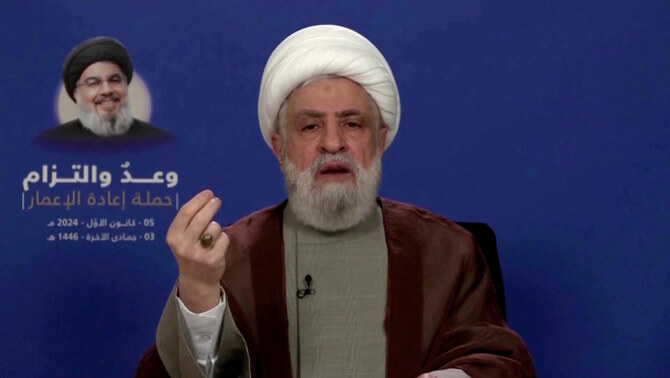
Speech by Hezbollah Secretary General Sheikh Naim Qassem, on August 5, 2025.
Delivered during the 40th-day memorial ceremony for Major General Mohammad Saeed Izadi (“Hajj Ramadan”), who headed the Palestine portfolio within Iran’s Quds Force and was martyred in Qom, Iran, during the 12‑Days War against Israel. This part of the speech, delivered on the same day the Lebanese cabinet was set to discuss Hezbollah’s disarmament, focuses entirely on Lebanon’s internal political situation.
Source: naimkassem.com.lb
Translation: Resistance News
[…] Let me now turn to the internal political situation. On this matter, I will address five key points.
First: What is the roadmap for building Lebanon and establishing stability? We believe that three fundamental principles are indispensable for building Lebanon:
1/ To share and cooperate within the framework of national unity, so that we become of one heart in the effort to revive Lebanon. This means partnership and cooperation.
2/ To set priorities that impact and establish the entire structure of Lebanese reality, rather than becoming preoccupied with superficial matters and external demands.
3/ To reject any form of tutelage, American or otherwise, because submitting to tutelage nullifies our capabilities and achievements and diverts us from our intended path.
Thus, we believe that building Lebanon requires firmly establishing these three principles:
-
Partnership and cooperation,
-
Setting national priorities,
-
Rejecting all foreign tutelage, whether international or Arab.
As for the (ceasefire) agreement concluded on November 27, 2024, it was an indirect agreement to cease Israeli aggression and its consequences. It was reached indirectly between the Lebanese state and the Israeli enemy. This agreement highlighted the close and exceptional cooperation between the Resistance (Hezbollah) and the state. That is, the Resistance facilitated all procedures required of the state under the agreement without causing friction, delay, disputes, or incidents.
On the contrary, for eight months, Hezbollah and the Resistance in general fully abided by the decisions and procedures of the Lebanese state, including the government, the Lebanese army, the presidency, and all relevant institutions. There was not a single violation in confronting the Israeli enemy, nor any failure to comply with the Lebanese army or cooperate with the state.
This is a model of how the Resistance can cooperate with the state when there is consensus, shared belief, and unity of purpose.
In contrast, Israel reneged on the agreement, failed to comply, and committed thousands of violations. And to be clear with you: what happened in Syria had a significant influence on Israel’s actions. Israel regretted the wording of the agreement, believing it granted Lebanon and Hezbollah the ability and potential to sustain their power in Lebanon. So they decided, “No, let’s continue here as we do in Syria. Let’s apply the same approach in Lebanon.” Hence, they now seek to alter the agreement, and they never abided by in the first place.
Lebanon’s interest lies in reclaiming its sovereignty, independence, and freedom. Israel’s interest is to weaken Lebanon in order to dominate its trajectory. Today, as officials, Resistance, people, army, and all concerned parties, our goal is to serve Lebanon’s interests, not Israel’s.
As for the Americans: the U.S. did not come to offer a new agreement. Whoever reads the proposal brought by (U.S. special envoy to Lebanon Thomas) Barrack will see that it is not an agreement; it is a set of dictates. It seeks to strip Hezbollah and Lebanon of all power and capability, to disarm the Resistance, and to deprive the people of their strength. In other words, it aims to leave Lebanon completely exposed before the Israeli entity.
What Barrack has proposed serves Israel’s interest entirely. I would like to quote some excerpts from the third memorandum, which is worse than the first and second.
Barrack’s memorandum to the Lebanese government states:
“Phase Two extends from 15 to 60 days.”
That is, in the first 15 days, under the pretense of ending aggression and similar titles, but it is only deception.
“From day 15 to day 60, disarmament must occur.”
They provide examples to clarify.
“It concerns mortars, rocket launchers, hand grenades and explosives, incendiary rockets, air-to-ground and ground-to-ground weapons, weapons causing mass casualties, biological and chemical weapons, and drones, all of which must be dismantled throughout the entire country within 30 days.”
Meaning: by days 15 to 30, we’re already at day 45, all capabilities must be dismantled and handed over to the Lebanese state. These are not heavy weapons. These are not even medium weapons. They are asking for the hand grenades. They want to confiscate launchers like mortars, which are considered light, conventional weapons, commonly possessed by (Lebanese) clans and various factions as readily as bread. We carry pistols, but they carry RPGs, mortars, grenades, and the like.
He says: all of this must be dismantled within 30 days. Better yet — put it in quotation marks — because someone might say: “Brother, it’s hard to dismantle all this in just 30 days.” No, thank God, they are reasonable and understanding. He replies: “What’s required is dismantling 50% of the (military) infrastructure by the 30th day.”
We were discussing this with one of the military leaders, and I asked him: “Who even knows what 50% means? They don’t even know what 100% is.” This is a trap. Tomorrow, they’ll come and say: “No, what you dismantled doesn’t amount to 50%.” Even if you were to dismantle up to 99%, they’d say: “You haven’t reached 50%.” We know the Israelis. We know how they operate.
If all of this is done, where will we be? At day 45. What happens then? Barrack says: “Israel will begin withdrawing from the five (occupied) points.” He says: “The success of Phase Two will facilitate withdrawal from three points.” Since there are five points, Israel will withdraw from all five, but to start with, it will withdraw from at least three points so that we can proceed to Phase Three, which spans from 60 to 90 days. At that point, we’ll begin discussing the release of prisoners.
What is this called? This is called: stripping Lebanon of its military capability by disarming its Resistance and preventing the Lebanese army from possessing weapons—except insofar as they serve an internal function and have no impact on Israel whatsoever. This is what is required to be implemented. Let us hypothetically accept that this memorandum proceeds: but what if Israel doesn’t even implement this hollow provision?
He said, “There are consequences for violations”—meaning, whether Israel violates it or Lebanon does. So what are the consequences for an Israeli violation? He said, “Condemnation by the UN Security Council and reviews of non-military engagement.” As the saying goes: “They told the liar: ‘Swear!’ He said: ‘By God, it came… but God took it with Him!'” (When a liar gets cornered, he doubles down.)
Are we now supposed to bet on the honesty of the Americans and the Israelis? And if we ask them to swear, will that make any difference? Are you offering guarantees? In any case, the Americans have already said, “There are no guarantees.” So what do we do if Israel oversteps its limits? File a complaint with the Security Council? Fine, go ahead—but in the end, you’re saying: “Israel’s hand remains free, even after all these concessions!”
On the other hand, what happens to Lebanon if, hypothetically, it fails to comply? They say: “Suspension of conditional military aid and economic sanctions.” But you’ve already destroyed Lebanon with economic sanctions and military aid since 2019 until now, and you’ve given nothing. The United States has disavowed everything related to the Israeli entity. What aid has America provided? What assistance has come from Arab countries or others? Has anyone given anything at all?
So what the memorandum demands is the dismantling of Lebanon’s strength in exchange for a partial, unguaranteed withdrawal—and negotiations between two sides with a severe power imbalance. What happened to the path we agreed on in the initial agreement? It means that the first agreement has been nullified, Israel has been absolved of all its violations, and we’ve entered a new tunnel labeled “A new agreement.”
We reject any new agreement other than the existing agreement between the Lebanese state and the Israeli entity. Let them implement the current agreement first, and only then can they talk about whatever they want.
Second point: anything that is related to Lebanon—any timetable proposed for implementation under the shadow of Israeli aggression—we cannot agree to it. Because a timetable implies commitment to an obligation while aggression is still ongoing. How can you set a timetable and fix deadlines requiring us to act, when the Israelis have done nothing so far?
Are we supposed to enter into negotiations or surrender our weapons without dialogue, without national consensus, without a defense strategy? This is wrong. We cannot accept that Lebanon commits to gradually surrendering its strength while all the cards remain in the hands of the Israeli enemy.
Second: What are they telling us today? “We are forced to remove the pretexts.” Why? “Because there is external pressure—funding is being withheld, sanctions are being imposed.” But have they given us anything in the first place? What benefit is funding to us if it comes at the cost of losing our independent decision-making, our violated sovereignty, continued occupation of our land, and the denial of all options? What is the value of this funding they might give us? It is worthless. Because we would become underlings, followers, slaves. And we do not accept to be slaves—not to America, not to certain Arab regimes, and not to any being on the face of the earth.
What do you say? External pressure? They’re withholding funding? Let them withhold it! They’re already withholding it. Is there any funding to begin with? Have they ever given us anything? Every time they say: “Once you implement this, we’ll give you something.” This is not something anyone should submit to. Let them issue all the threats they want.
They say, “They’re frightening us with (the threat of) war and escalation of the aggression.” I ask you: Why is Israel currently relying on this strategy of limited aggression and American political pressure, rather than launching a full-scale war? Because it’s in Israel’s interest to avoid full-scale war. Because if war erupts, the Resistance will defend itself, the army will defend itself, and the people will defend themselves. That defense will lead to missiles falling within the Israeli entity, and the entire security system they’ve built over eight months will collapse in an hour. And who knows how long it would take them to rebuild it?
So, it is in their interest not to wage a major war, so they don’t have to face the Resistance’s retaliation and defense. This is their interest, and that’s how they think. So don’t be too intimidated by them. They can launch a war at any moment anyway. Why? If you surrender everything, will that stop the aggression? No—it will not stop. Because they will then hold everything in their hands. On the contrary, if we are left with nothing, the likelihood of aggression and (war) crimes will only increase tenfold—more than ever before. If we are left with nothing, who will protect Lebanon and the Lebanese people?
Did you not hear (Israeli) Finance Minister Smotrich? He’s a leading figure in the Israeli government. He said: “The Israeli army will not withdraw from the five points in southern Lebanon, and the villages destroyed by the Israeli army in southern Lebanon will not be rebuilt.” He is saying this openly to you. Yet some people among us say: “No, that’s not true. These are just words…” How could these be just words? Everything they’ve said, they’ve done. And even what they haven’t said, they’ve done. Therefore, if the international community really wants Lebanon to be stable—if stability in Lebanon matters to them—then rest assured: they will back down once Lebanon proves itself. And if Lebanon’s stability means nothing to them, then no matter what we offer, it will mean nothing. No one should believe this is a matter of what we’re offering.
Today, their support to the Lebanese army is minimal. Why? Because they view it as support limited strictly to internal matters. When it comes to Israel, there is no support. So this is not a real support.
In 2019, protests erupted, and change began in Lebanon. From 2019 until today, what have they been telling us? “Do what we ask, and we’ll give you this and that.” America—alongside some Arab countries—has exhausted Lebanon under the slogan: “Implement, and we will deliver.” Today, we have a president, a government, institutions in the making, and a stable domestic situation. The entire crisis we face today stems from the Israeli aggression.
Here, I return to the ministerial statement, because we always hear: “Let us return to the ministerial statement”—as though the Resistance is demanding positions outside those of the state. So, what does the ministerial statement actually say?
The third paragraph states:
“The first goal the government places before its eyes, and the noblest mission it commits to fulfilling, is to work toward the establishment of a state governed by law in all its aspects, to reform its institutions, and to fortify its sovereignty.”
Tell us, O Government: Where are you working to fortify sovereignty? Tell us, what practical measures have been taken to strengthen sovereignty? Is giving up arms considered a reinforcement of sovereignty? Is surrendering to Israel a reinforcement of sovereignty? Is handing over weapons to Israel—at its request, and at the request of the U.S. and some Arab countries—what is required at this stage? And will that bring sovereignty to Lebanon?
The fourth paragraph that follows states:
“The state we seek is one that fully assumes responsibility for the security of the country and the defense of its borders and frontiers—a state that deters aggressors, protects its citizens, and fortifies independence.”
So where is the deterrence of Israel? Where is the state that protects Lebanon from evil? Where is the responsibility for security in the face of the Israeli enemy? Where is the defense of the borders and frontiers?
You tell us that for now, you are powerless. If you are powerless, do not render yourselves even more powerless! You say, “Right now, we cannot,” and we say to you: “Take your time. Let us build capacity. Let us establish a military plan so that the army will have the military capabilities, the human resources, and the ability to confront the Israeli enemy if it attacks us or continues its occupation.”
Now, you state in your ministerial statement—in the fourth paragraph, meaning in its very introduction—that you want to preserve the defense of the borders and frontiers, and that this state will deter aggressors. So give me your program for deterring the aggressor. Give me a timetable for deterring the aggressor. Give me practical steps for deterring the aggressor. Where are they? It has been eight months, and there is still no deterrence. Nothing.
In the fifth paragraph, the Prime Minister has always boasted—and rightly so, for this paragraph is indeed very important, and we all take pride in it as he does. He took the paragraph from the (1989) Taif Agreement (also called the Taif Constitution, as it amended the Lebanese Constitution of 1926 in significant ways).
And what does Taif say?
“The government commits itself, in accordance with the National Reconciliation Document adopted in Taif”—and this is written explicitly in the ministerial statement—“to take all necessary measures to liberate all Lebanese territory from Israeli occupation and to extend the sovereignty of the state over all of its territory.”
The very first thing you must do is take all necessary measures to liberate Lebanese territory. What does “all measures” mean? It means the Army. It means the People. It means the Resistance. It means the political parties. When the country is threatened, all forces are responsible for defending it and confronting the threat. So, at the heart of Taif—at the heart of the National Accord, which you yourselves referenced in the ministerial statement that we all agreed on—you said:
“By taking all necessary measures to liberate all Lebanese territory from Israeli occupation.”
Show us: Where are those measures being implemented? Where are the actions that prove our readiness to confront the Israeli enemy?
The state must develop plans to confront pressure and threats, and to ensure protection—not strip its citizens of their strength and capacities, strip the Resistance of its strength and capabilities, and lose the sources of power that enable it to demand, negotiate, assert itself, confront aggression, liberate land, and establish real sovereignty for Lebanon. This is the role the state must fulfill.
This means that we must go to the Council of Ministers and place an item on the agenda: How do we confront Israeli aggression and protect our sovereignty? What are the practical steps? What is the timetable to achieve them? What are the sources of strength we can rely on? How do we involve the parties, the forces, the sects, the people, and all concerned in the process of defending Lebanon? How do we unite to expel Israel? How do we escalate pressure on the Israeli enemy through its complicit sponsors, or through any available means?
This is what must be done. We must put together a comprehensive program on this issue and set a timetable for it. This is the real priority—not the priority of disarming the Resistance to appease Israel, nor disarming the Resistance because America and some Arab countries are exerting all their efforts to pressure us into accepting that this is the priority.
They tell us: “What do you want with Israel? Even if it remains (as an occupier, we must disarm).” Where is (Lebanese) sovereignty? Are you working for Lebanon—or for someone else? If you are working for Lebanon, if you care about Lebanon, then you must support ending the aggression, ending the Israeli occupation, beginning reconstruction, and releasing the prisoners. After that, come and talk to us about whatever you wish. We will be ready.
And I say it clearly: The Resistance is part of the Taif Agreement—stipulated within the measures that must be taken by all means to protect Lebanon (the Taif Agreement called for the disarmament of militias, with the explicit exception of Hezbollah, considered a Resistance movement against Israeli occupation). A constitutional matter is not debated by a vote. A constitutional matter requires consensus and the participation of all segments of society to reach a common understanding.
Likewise, the abolition of political sectarianism requires broad consensus. So too does the abolition of the principle of numerical dominance in favor of sectarian distribution that reassures all sects—this too is a constitutional issue. And likewise, Resistance against Israel is a constitutional matter—one that must be discussed through consensus.
Let us open a national discussion about a defense strategy and national security strategy. National security goes far beyond the issue of weapons. It considers Lebanon’s strength—how to build it, how to consolidate it, how to accumulate and harness it in order to defend against and confront the Israeli enemy.
The strategy is not a timetable for disarmament. We were waiting for the day when we, as the Resistance, could sit down with the concerned parties to discuss the nature of the national security strategy. But it seems that they have set aside the national security strategy altogether, and the issue has become simply: “Hand over your weapons—there is no national security.” How is that acceptable? We reject this, because we consider ourselves a fundamental pillar of Lebanon. Therefore, the approach must be re-evaluated.
Third, we are committed to preserving cooperation between us and the three presidents (President of Lebanon Joseph Aoun, Prime Minister Nawaf Salam, Speaker of Parliament Nabih Berri). We are committed to dialogue, to mutual understanding, and to cooperation—without one party pressuring another, and without someone feeling pressured then turning to pressure us internally. No. No one is under pressure. In the end, everyone knows that Lebanon is the root. Whatever benefits Lebanon, we must do it. It is unacceptable to let yourself be subjected to pressure and then ask us to relinquish our rights and sovereignty. That is fundamentally wrong. We and you must stand together. Tell the West, tell the Americans, tell all those exerting pressure: we have strengths and resources in Lebanon, and we want to come to an understanding among ourselves. You cannot force us.
We must also be wary of those who incite internal discord, those whose hands are stained with blood (Lebanese Forces, Kataeb), and those who serve the Israeli project—both inside and outside the country.
I urge you not to waste your time with the tempests stirred up by external dictates. Today, the entire country is confused from top to bottom. No one is at ease because Barrack came and threw down the first memorandum, the second, and the third. Come on, stand up (like a man)! What is the story? Every time someone speaks, or an Arab official comes to our officials and says, “Do this… or else…,” what does “or else” mean? “Or else there will be no money?” There has never been any money. And who are you to buy us with money?
What are you saying? This is a country—a country where sacrifices have been made, where blood has been shed. When it comes to Lebanon, we discuss Lebanon within Lebanon. No one outside Lebanon should discuss what we, as Lebanese, must do. No one imposes dictates upon us. We do not want to make agreements with anyone from outside. We want to come to agreements among ourselves—for our sovereignty and independence.
We, as Lebanese, will arrange our internal affairs through cooperation and mutual understanding. And let it be known: there will be no solution without consensus. This is a strategic, foundational issue. Let them implement the (ceasefire) agreement—and we will implement what serves our interests in Lebanon—through consensus among ourselves, through our institutions, through the army, and through the Resistance, which is an inseparable part of this fabric.
I tell you: Today, the Lebanese state is able to stand strong and declare to the international community that it is responsible for the southern and eastern borders (with Israel and Syria). Let them ask the Lebanese state to act if something happens on the southern or eastern borders. This is an eight-month experience of the Lebanese state. Nothing has happened on the southern border. The state also maintained control over the eastern border and prevented massacres, strife, and complications in those villages. The Lebanese state continues to carry out its full duties internally.
Tell the world: If the requirement is that Lebanon not interfere with anyone, then the Lebanese state guarantees that it will work to protect its borders and its sovereignty, and that it bears responsibility for what happens within. From within, it can stand before the world—and before you—with (this 8-months) experience. Let the international community hold Lebanon accountable if it fails. But let it not interfere to demand that Lebanon fulfill Israel’s goals—goals it could not achieve through war. No. No one can strip Lebanon of its power to protect its sovereignty, its policies, and its capacities. No one can prevent Lebanon from being proud. Keep this idea in your minds. Let it be your foundation.
We are a group that has given and sacrificed. The Lebanese have sacrificed. The army has sacrificed. The people have sacrificed greatly. No one should come and tell us that he is the one who will take care of us. That time is over.
Fourth, those who made sacrifices and liberated the land are more patriotic than those who tampered with the homeland and killed its citizens. No one should now come acting as if they are noble and pure, or try to play the role of the blameless and innocent. No. Everyone has a known history—and our history is known too. Our history lies with the master of the nation’s martyrs, Sayyed Hassan Nasrallah, may God have mercy on him, who departed to be with Almighty God as a great, brave, and valiant martyr. He gave to humanity—not only to Palestine and not only to Lebanon—what many others did not give.
We have this sacrifice. We have Sayyid al-Hashimi (Hashem Safi al-Din, Nasrallah’s assassinated successor). We have the martyred commanders. We have 5,000 martyrs in the Battle of Al-Aqsa-Flood and the Battle of The Mighty Ones (66-days war against Israel in from september to november 2024). We have 13,000 wounded as a result of these battles. We have destruction, displacement. All of this was offered to halt the aggression—and we did stop the aggression.
They asked us: What did you do? We stopped the aggression. That aggression would have reached Beirut. It would have seized everything. That aggression sought to change Lebanon’s character, its presence, its geography, its strategy, its future. The Resistance, the Army, and the People prevented the Israeli enemy from achieving its objectives—through these massive sacrifices.
You ask me: What we sacrificed made our situation more difficult. No. No. No. The Resistance is doing well: strong, proud, full of faith and resolve, and determined to be the master of its land—and for Lebanon to be independent, sovereign, and proud. The supporters of the Resistance are steadfast, patient, and united. The Resistance fighters are ready for the ultimate sacrifice. And the meaning of the ultimate sacrifice is known to all.
As for the great crown and the great banner—I was watching an episode yesterday, Monday, on Al-Manar TV about the wounded in the pager attacks. Are these people “wounded”? These are heroes. These are proud ones. These are living martyrs—witnesses against all those who have abandoned (Gaza). The wounded of the pager attacks, and all the wounded, are people of insight and determination.
Did you hear their words? Can you believe a young sister who has lost her sight (both eyes), yet she sees with her heart, her mind, her faith, and her courage—and she says she wants to specialize in artificial intelligence (AI was a key weapon in Israel’s ability to strike major blows against Hezbollah) and graduate with honors in the baccalaureate exams? What generosity! What resolve! Or the other who graduates with high distinction and says: “I want to study psychology to help people.”
Each one carries a different banner, but they are united by determination, by faith, by steadfastness. If Israel believes our wounded are out of the equation—no, our wounded are ablaze, our wounded are stepping forward, our wounded are advancing. By God, these examples are truly great.
See this English documentary about the pager terror attacks
Today, I want to say to you, O wounded of the pager attacks—all the wounded—I hope you will accept me as a companion walking the path with you. There can be no journey without you. The journey shines because of you, O wounded ones, O living martyrs, O generous souls—those who, when someone hears you speak, they say: here are cultured people, philosophers, lovers of God Almighty, people of exceptional and distinct insight, believers in the Wilayah (allegiance to the Imams after the Prophet), lovers of Muhammad and the family of Muhammad—may God’s prayers and peace be upon them all. This model cannot be defeated, nor can it be broken.
To those who wish to listen, I say: what do we have? We have these wounded who passed their exams. And here, I want to congratulate all those who succeeded in their exams—of all sects, denominations, and regions. But truly, the remarkable successes, with very good and excellent grades, achieved by the wounded of the pager attacks, are a great and important matter.
We also have the honorable patriots of Lebanon. Do not think that the Resistance is just Hezbollah and the Amal Movement. No. The Resistance includes political parties and forces, figures from various sects, from different political backgrounds, with varying ideologies—secular, religious, communist, and others. They all consider themselves part of the Resistance. We have this reserve, this vast and valuable reserve. Let no one assume our reserve is limited—no.
Know that our enemy is not all-powerful, and has not yet achieved its goals. It has not. Do not allow it to succeed through defeatism. My brother, do not be defeated. We are not defeated. Who gave you the right to speak on our behalf? Who told you to stand there, afraid of others? Be strong!
In any case, when someone pressures you, say to them: go refer to the Resistance—and then let’s see what we and they will do.
“O you who believe, be patient, and persevere, and remain steadfast, and fear God so that you may prosper.” (Qur’an, 3:200)
The title of this stage is: We are steadfast, and we will overcome this stage, God willing, and we will remain proud.
Know that this Resistance group—Amal Movement, Hezbollah, all the honorable Resistance fighters—alongside the Lebanese Army and the Lebanese people, will remain in the field, and they will triumph. These are the people of “Far from us is humiliation.” (Imam Hussein’s resolute declaration when faced with a choice between the sword and disgrace, affirming that an honourable death is better than a life of submission).
I conclude with the fifth point: Lebanon finds stability through all its people—not by favoring one group at the expense of another, nor one faction over others. In a stable, unified Lebanon, the state with all its components—including the Resistance—is one single entity. There are not two sides: one called the state and another called the Resistance. No. We are part of the state’s structure. The Resistance is part of the state’s structure.
Know that we are in agreement and in cooperation. Today, some are wagering that there is discord between Hezbollah and Amal. No, no, no, no. There is no discord. On the contrary, we are like peas in a pod—we understand each other, and we are at the heart of things, and if someone doesn’t like it, let them bang their head against the wall.
No one should think they can intimidate us, for those who possess dignity and Resistance can only be proud and strong—preserving their strength and protecting their people.
Know that in this battle today, either Lebanon—all of Lebanon—will win, or Lebanon—all of Lebanon—will lose. No one in Lebanon will win while another loses. No. Either we all win together, or we all lose together. And we are convinced that we can win together—and we can win together. But when the agents of sedition and some defeatists begin to stir up strife and complications, and exploit Lebanon for the sake of foreign interests, they are the ones who push Lebanon towards defeat. And if some among us prioritize their personal interests—interests that intersect with Israeli interests—above everything else, then they are responsible for whatever harm befalls Lebanon.
The problem is the aggression, not the weapons. Resolve the problem of aggression, and then we can talk about the weapons.
The solution lies in possessing the means of power—not in relinquishing them—and in relying on God and honorable people, not on the oppressive American wolf and its underlings. We must be lions to overcome this phase—not sheep, devoured without a trace.
“O you who believe, when you encounter a group, stand firm and remember Allah much, so that you may succeed. And obey God and His Messenger, and do not dispute, lest you fail and your strength depart. And be patient—indeed, God is with the patient.” (Qur’an, 8:45-46)
We will face foreign tutelage, American-Arab encroachment, and internal bullying. This is undoubtedly a dangerous stage in Lebanon’s independence—but we are stronger through independence, through the triad of the Army, the People, and the Resistance, and through national unity. This is what we will work toward.
Peace be upon you, and God’s mercy and blessings.
To support our work, you can donate, share this article and subscribe to our newsletter.
 Resistance News Unfiltered
Hezbollah Secretary General Sheikh Naim Qassem tells the truth! Steadfastness!
LikeLike
As always, we are grateful for your work.
Blessings
Amarynth at GlobalSouth.co
LikeLike
Thanks Amarynth!
Please correct the date of the speech. It was August 5, and not June 26.
LikeLike