
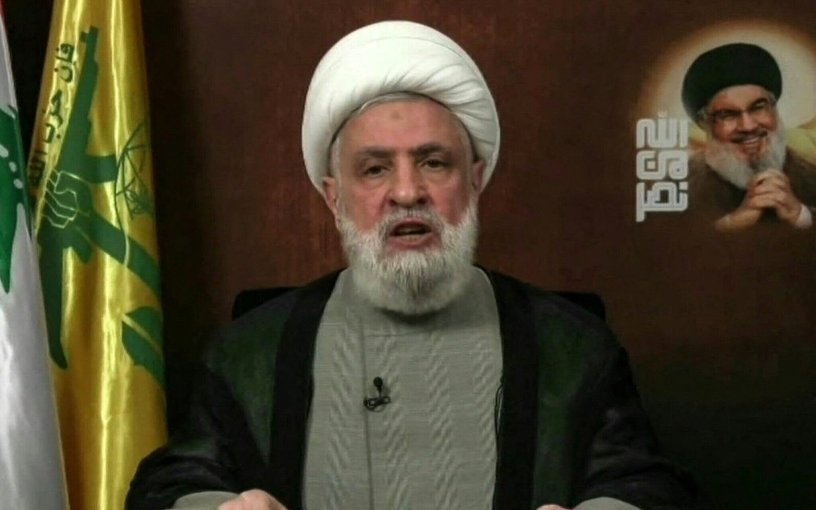
- Speech on June 26 on the Israel-US Aggression Against Iran
- Speech on June 28 on the Situation Between Hezbollah and Israel
Speech by Hezbollah Deputy Secretary General Sheikh Naim Qassem on June 26, 2025, on the occasion of the first night of the month of Muharram and the Ashura commemorations.
Source: naimkassem.com.lb
Translation: resistancenews.org
For a full account of the martyrdom of Imam Hussein in English, see Maqtal al-Hussein
[…] The path of Imam Hussein—peace be upon him—has its supporters and adherents. The Islamic Republic of Iran follows the path of Imam Hussein—peace be upon him—and tonight, I will speak about the Islamic Republic from a political standpoint, leaving other political analyses for upcoming nights, for lack of time.
The Islamic Republic has been the target of a global Israeli-US aggression—an unjust and deceitful aggression based on entirely baseless accusations. Since the triumph of its revolution in 1979, under the leadership of Imam Khomeini—may God sanctify his soul—and its subsequent rise some 46 years ago, the Islamic Republic of Iran has succeeded in effecting a profound transformation, not only within its own borders but also on a regional and global scale.
Imam Hussein’s legacy—peace be upon him—lives on within the Islamic Republic, embodied by those who take positions, set directions, make decisions, and offer sacrifices. Let us give a brief assessment: why did this Israeli aggression against the Islamic Republic of Iran take place? I will offer you four reasons:
First, the primary objective of Israel and the United States is to strike down any independent force that supports resistance in our region and to neutralize any leaders who aim at the Liberation of Palestine. Iran’s “great crime” is that it has supported Palestine, Al-Quds (Jerusalem), and the Palestinian people in their struggle to reclaim their usurped and occupied land. Even today, when the United Nations refers to Israel, it speaks of the “Israeli occupation”—an occupation that has persisted for 75 years, continues to this day, and which, God willing, will end when the occupiers finally leave this land for good.
Thus, the first reason is that Iran represents an independent power that supports the resistance—something the enemies cannot tolerate.
Second, Israel is an expansionist entity. May God grant us awareness of this, may the peoples understand it, may the world recognize it: Israel will not be satisfied with the 1948 territories of Palestine, nor even with all of Palestinian territory in its entirety. It will not stop at the occupation of the Golan Heights or beyond. Israel seeks to assert its control over the entire region, and it is bounded only by the limits of its own capabilities. And it will not stop, as facts and events have shown. Israel pursues a policy of ever-increasing expansion and domination, in its own interest and that of the US tyrant, who uses Israel as a tool to colonize and extend its reach. It is in the context of this expansionist project that Israel attacked Iran.
Third, there is no legitimate justification for this aggression, aside from the spurious pretext that Iran is seeking to acquire nuclear weapons. Yet all the available evidence indicates that Iran’s nuclear program is peaceful. In accordance with international law and the regulations of the International Atomic Energy Agency, Iran has the right to develop a peaceful nuclear program. Inspectors from the Agency are present in Iran’s nuclear facilities and are familiar with every detail. All their reports confirm that no military activity exists. But Iran’s enemies needed a slogan for their operation. They cannot openly declare that they intend to attack Iran, so they claim that Iran is a threat because it might one day consider military action. Their “evidence”? The fact that Iran has a peaceful nuclear program! And who knows what Iran might do in the future? Therefore, they say, it must be confronted now. Very well: are we now to judge intentions and wage war based on supposed future intentions? That is their pretext. And still, Israel needs no justification to launch its aggressions.
Fourthly, this aggression has exposed a crucial truth: no matter the global influence of the United States, no matter its attempts to manipulate the media and mislead public opinion, nearly every country and people around the world condemned Israel’s assault on Iran. What does this near-unanimous reaction indicate? It means that this act is of exceptional ugliness, that its criminal nature is self-evident, and that it constitutes, without ambiguity, a direct attack on a sovereign state.
What were the outcomes? In light of the pretexts used to justify this Israeli aggression—backed by the United States—what tangible results were achieved?
First, the Islamic Republic of Iran thwarted all three of the aggression’s intended objectives. These objectives were: first, to halt nuclear enrichment. Yet Iran continued its program—and will continue—regardless of the damage inflicted, because it possesses the necessary knowledge, will, and determination. The attempt to stop the peaceful nuclear program has therefore failed.
Second, they sought to target the missile program. Why? Because missiles constitute a means of defense. And their aim is to prevent nations from defending themselves, to prevent peoples from protecting themselves—so that they may impose their will freely, so that Israel might move in and out of Iran at will. But the missiles stand in their way. What happened? They failed to eliminate the missile system, which remained operational and continued to inflict serious damage on the Israeli entity.
Third, they aimed to overthrow the regime. By targeting command centers, issuing direct threats against His Excellency the (Supreme) Leader—may he live long—and intensifying attacks on nuclear and ballistic installations, they imagined that the Iranian leadership would waver, allowing Israel to collaborate with another force to seize control of the Iranian scene. That, too, did not happen.
Israel’s three objectives in its assault on Iran—to dismantle the nuclear program, to wipe out missile capabilities, and to topple the regime—have all failed completely, by the grace of God.
Today, after twelve days (of war), we consider Iran to have emerged victorious. The ceasefire is clearly in Iran’s interest, as it brings the aggression to an end. It represents an explicit and official recognition of the failure of the objectives pursued through this attack. That is the first result.
The second result is the emergence of an unprecedented popular consensus. Iran is a free country, where opposition exists alongside support, where some oppose the regime and its policies. There is both internal and external dissent. And yet, it is striking that most of the groups critical of the regime rallied behind the state when Iran—as a sovereign entity—was confronted with such a threat and such aggression. A genuine popular consensus has taken shape, and its significance is considerable.
This consensus coalesces around the leadership—around the Imam, the Guide, the supreme religious authority, Grand Ayatollah Imam Khamenei—may his shadow endure. This unity is meaningful: it reflects the deep impact of what the Leader and the Revolution have cultivated in this people—their devotion, and their armed forces: the blessed Guardians of the Islamic Revolution, the army, and all the security and military forces that have stood firm, offering martyr after martyr, commander after commander, mujahid after mujahid—ever-present on the battlefield, steadfast, powerful, courageous, fearing none but God, the Most High. This is a magnificent achievement.
Iran possesses unmatched strength, founded upon three essential pillars. Let no one imagine Iran to be an easy target. No—its power is unparalleled, and rests on three foundations:
First, a courageous, wise, and inspiring leader—one who faces trials, who stands firmly on the ground; who fears no reproach in the cause of God (Qur’an, 5:54); who advances, carried by divine light and upheld by the support of the Most High, assured of victory. From the very first day, he declared: “Help from God and a near victory” (Qur’an, 61:13). This is a pillar of the highest importance.
Secondly, a people with an exemplary history—from the initial triumph of the Islamic Revolution to the present day. How much they have endured, how much they have suffered! The war launched by Iraq against Iran lasted eight years, during which the people sacrificed millions of martyrs and wounded. Yet they remained united behind their leadership, unwavering in their dedication and sacrifice, until Iran emerged victorious. At that time, Iraq led the charge, but in truth, the entire world—every nation without exception—had rallied against the Islamic Republic of Iran, determined to bring down the Islamic regime in power. They failed. Because there was this Leader, and there was this people.
Thirdly, the blessed Guardians of the Islamic Revolution and the security forces, heirs to a long legacy of sacrifice. If the Guardians go throughout the region for the sake of Palestine, if they support the oppressed across the world, if they train free men wherever they are, how could one doubt that they would make contributions of exceptional magnitude to their own homeland? That is precisely what the Revolutionary Guard Corps has accomplished on every field of honor—alongside the security services, the army, the civil administration, the officials, and all those who have worked along this path.
Thus, Iran has demonstrated—by the grace of God—that it is a great power, built upon three solid foundations: its leadership, its people, and its armed and security forces—the army and the Revolutionary Guards.
Fourthly, Iran has proven—and this deserves particular emphasis—that it is capable, single-handedly, of standing up to the global tyrant that is the United States, backed by Israel and a large portion of Europe. And it has done so alone. Iran receives no military aid from any other country. It has no air cover, no supply lines for ammunition, no other state fighting alongside it. No— the Islamic Republic of Iran has stood firm, alone, relying solely on the means it has developed, on its own capabilities, in the face of the US war machine, in the face of the plane-loads of weapons and munitions shipped (daily) to the Israeli entity, in the face of spy networks, media campaigns, political pressure, intrigue, and multifaceted plots. And despite all this, Iran has remained upright—alone.
It is no small thing to say that it has faced such a confrontation alone, and declared: “Here I am.” May God bless this noble people. May He bless this young, generous, and devoted Iran, which, on its own, inflicted heavy losses upon the Israeli entity—an entity that hastened to call upon the United States for help, thus proving once again that it is incapable of surviving even a single day without permanent, multifaceted, and unconditional US support.
You say Israel is strong? No. Israel is not strong. Israel exists solely to implement the decisions of global arrogance (imperialism)—today embodied by the United States and its allies.
Fifth, Iran has consolidated its place on the regional and international stages. No one can now pretend not to know who Iran is or what it represents. On the contrary—it has strengthened its standing, through its principles and its choices, without ever compromising. Post-war Iran is stronger than pre-war Iran. It remains the unwavering supporter of the resistance, an independent republic, the ally of its neighbors and friends. It has shown itself capable of ensuring the region’s collective security—without the need for the United States or its allies.
Iran has clearly demonstrated that US interference in the region serves only one purpose: the protection of Israel, to the detriment of the region’s peoples. Let no one imagine that the US bases established here serve to protect the inhabitants. No. They protect Israel. This is confirmed by the current US aggression against Iran, made possible by the military infrastructure deployed across the region. Do they protect the peoples of the Middle East? No. They protect Israel—Israel, which continues to this day its genocide in Gaza, in full view of the entire world.
Where is the world? Where are the states? Where are those who call themselves humanitarians? Is all you know how to do talk? We demand action. We demand positions. We demand decisions. May they learn from the example of Iran. May they take inspiration from Iran, which stood tall, prevailed, and was able to declare loud and clear: Iran is independent.
As for us in Lebanon, as Hezbollah, we stand in support of Iran’s independent choices. We reject occupation and US hegemony. Some ask: why such a deep bond with Iran? Because Iran embodies dignity and honor. Because it stands with the oppressed. Because it has given us everything, without ever asking for anything in return. So why would we not stand by its side? We share the same vision, the same convictions, the same practical direction, the same struggle against occupation. Everything Iran does is marked by honor. Tell me—where else can you find such honor? What are others doing for Palestine? What are they doing for Lebanon? For justice? Let them tell us! Meanwhile, Iran is taking action. Yes, it is only natural that we say: we stand with Iran, we are alongside Iran, we are proud to be with Iran—under the banner of the wise, courageous, and eminent leadership of Imam Khamenei, may God protect him.
Brothers, this is a matter of faith, of life and the hereafter, of sincerity and noble sacrifice. It is the education of a nation for the sake of its future. It is therefore natural that we are where we are—and absurd that others reproach us for it.
The enemy is one: the Israeli enemy. And our path is clear: we are working for the liberation of the land, for independence, for the building of the homeland. We will not submit to dictates. We will not bow before occupation. This is our life, this is our country. We want it to remain precious to our children and to generations to come. We will resist for this cause, no matter the price, no matter the consequences. We are the sons of Imam Hussein, the sons of the master of the martyrs of this Ummah, Sayyed Hassan Nasrallah, the sons of honorable mujahideen, the heirs of this proud lineage.
In conclusion, I wish to apologize to this beloved audience. I would have liked to address you directly, to be physically among you, and to earn the reward of taking part in these assemblies—for their value and merit lie in physical presence, not remote participation. But security considerations have prevented me from doing so.
I am confident you will forgive me. In any case, we implore God Almighty to lift this trial that weighs upon this Ummah.
May the peace, mercy, and blessings of God be upon you.
***
Speech by Hezbollah Deputy Secretary General Sheikh Naim Qassem — June 28, 2025, on the occasion of the third night of Muharram and the Ashura commemorations
Source: naimkassem.com.lb
Translation: resistancenews.org
We are translating the last part of the religious section on divine help, as well as the entire political section, which focuses on Hezbollah’s struggle against Israel since October 7, 2023.
Religious Section
[…] So, is martyrdom merely synonymous with death and an end? No—martyrdom is victory. A victory whose fruits endure across generations, sustained by the continuity it creates.
Today, I would like to address a question that is often asked: If we are believers, connected to God Almighty, and if the Lord of the worlds declares in the Quran, “It is incumbent upon Us to help the believers” (Quran, 30:47), then does God always grant us victory? Or does He do so only at times? And if He does not always grant us victory, does this suggest that some specific obstacle prevents Him? Or is it that, by virtue of our belief alone, we should always prevail—regardless of life’s hardships and trials?
I would like to delve deeper into this matter, as it is both delicate and fundamental. God, the Almighty, has established divine laws for this worldly life: rules and systems. One who takes up the sword can strike and wound; but one who carries no weapon and remains passive cannot inflict harm. Likewise, those who engage in battle may hope to win—provided their numbers are sufficient, their preparations adequate, and their training rigorous. But if training is lacking or material means are insufficient, they may fail to shift the course of the battle.
Such is the divine law: man must equip himself with the means necessary for success. At times, he may fall short in preparation; at other times, the enemy possesses far greater capabilities and vastly superior resources—and in that case, the enemy may triumph over the believers on the material aspect. Indeed, according to divine law, the one who is better prepared prevails—because he made the necessary preparations, while you lacked the means. I do not say that you failed, but rather that you were unable to succeed. We must therefore accept this as a natural reality.
God, the Almighty, deals with us first and foremost in accordance with the divine laws He has established. If you want to pass your exam, you must study. It’s not like those who say, “We prayed fervently the night before the exam, yet we still failed the next day.” You failed because you did not study. You cannot succeed without making the necessary effort. Do your part, and leave the rest to God Almighty. Prepare yourself, and the outcome rests with Him.
What does God, exalted be He, say? “Prepare against them whatever you can of power and steeds of war.” And then what? “By this, you will strike fear into the enemies of God and your own enemies” (Quran, 8:60). That is: do your duty, make the necessary efforts, and rest assured that this alone will cause them to fear you. This may take effect even in the initial phase. Then, in a second stage, if the means are adequate, God, the Almighty, will grant His support and His blessing, enabling success. But at times, this assistance is delayed because the material conditions have not yet been met. These are unseen realities beyond our grasp.
We must therefore believe that divine laws are at work. But then—what is the difference? The believer does benefit from God’s support. How so? God says: “If there are twenty among you who are steadfast, they will overcome two hundred” (Quran, 8:65). According to natural law, the ratio should be one to one—and two men should overpower one. But God says: no. Through your faith, your convictions, your devotion to Muhammad and his family—may God’s peace and blessings be upon them—through your reverence for the blood of martyrs, and your offering of your own life to God, the Most High, He declares: “Twenty shall overcome two hundred”—one against ten.
Where does this multiplier come from? Not from physical strength, but from moral fortitude, from divine support, from this unseen assistance—even if we do not know how it arrives or how it operates.
I tell you this: the young men who stood on the front lines during the Battle of the MightyOnes (the war between Hezbollah and Israel from September to November 2024) fought with remarkable valor. When you compare their numbers to those of the five Israeli divisions, totaling 75,000 soldiers, you may wonder: Is it even conceivable that a few hundred fighters could have resisted 75,000 heavily armed troops? And I will answer: Yes—because they had prepared themselves and offered their lives to God, the Almighty. And God guided them.
How did He guide them? I do not know. God has His own ways of aiding His servants: He sends angels, He strengthens resolve, He breaks the enemy’s spirit, He introduces unseen forces beyond our comprehension. God knows them; we do not. We are not required to understand the mechanics of divine aid. What matters is our certainty that God is with us, that He supports us, and that every victory, at any stage, is a divine victory—for both the laws and the help come from Him.
And if at times we hoped for a particular victory and did not achieve it, let us ask ourselves why. It may be due to our own limitations, to a glaring imbalance of power, or to the need to reassess and correct our calculations. This is only natural. But when we do achieve victory—even material, tangible victory—it means that all our efforts have borne fruit, and that God, the Almighty, has granted us favors we could never have attained on our own.
What does God, Most High, say about the fighters at Badr (the first battle between Muslims and polytheists)? “God granted you victory at Badr when you were weak.” (Qur’an, 3:123) In other words, you were weak and could not rely on your own strength alone. Three hundred and thirteen against nine hundred and fifty, with weapons and equipment—roughly one against three: an obvious imbalance. We do not know the full extent of the disparity, but when God says, “If there are twenty among you who are steadfast, they will overcome two hundred,” it means that in terms of effective strength, the 313 fighters were the equivalent of 3,130. Then God sent them angels and bestowed His help—but that belongs to another domain.
In the end, God came to their aid because they gave all they had. And the victory was theirs.
We therefore affirm that every victory we achieve is a divine victory. Why? Because this is the divine Sunnah—this is the way of things—and because we tangibly feel blessings reserved for believers, graces that non-believers can neither obtain nor even perceive.
I was watching some old reports on the period of the Israeli withdrawal in 2000, what is known as the Victory of 2000. Israeli soldiers were asked: How did the fighting go? They replied: “Brother, sometimes it felt like riders on horseback were chasing and catching up with us.” Where did these horses come from? I don’t know. Was it an illusion? Did the horses actually appear to him? Did God—exalted be He—send them? That is not our concern. This is part of divine aid. Do not get lost in such details. What matters is that we are convinced we are supported by God—exalted be He—and God, exalted be He, must necessarily support the believers: “It is incumbent upon Us to help the believers.” (Qur’an, 30:47)
As for the trials that afflict us in this world—is not the whole of earthly life a test? Do you expect to triumph and succeed without facing hardship? Without undergoing an exam? These are tests, trials. We are tested in one place, we succeed in another; we fall ill, we suffer, we recover, we rise again—such is the nature of life. These are nothing but trials, to the point that God—exalted be He—says to the believers: “Do you think you will enter Paradise without having endured what those before you endured? Misery and affliction befell them, and they were shaken until even the Messenger and those who believed with him cried out: ‘When will God’s help come?’ Indeed, God’s help is near.” (Qur’an, 2:214)
Fear not—you will eventually prevail, for your path is right, your direction is right, and the means at your disposal are right. You need only be patient.
In the noble hadith reported from the Messenger of God—peace and blessings be upon him and his family—he said: “Victory comes with patience, relief with affliction, and with hardship comes ease.”
You must be patient. Things do not always happen at the moment you deem best. Leave the timing to the Lord of the worlds. You must simply do what is required of you. What matters most is to fulfill your duty.
From this point, when we contemplate the uprising of Imam al-Hussein—peace be upon him—and what he accomplished in Karbala, what can we conclude? We conclude that Imam al-Hussein—peace be upon him—took a stand and fulfilled all the necessary conditions to go to Karbala. From Medina, he had declared: “I have risen up only to seek reform in the community of my grandfather, the Messenger of God.” He refused to pledge allegiance (to the corrupt Yazid, son of Mu’awiya). His position was therefore clear on a personal level. He departed for Mecca and then received letters saying: “We are ready to follow you.” He was thus entrusted with leading the group, since they were prepared to engage in war, in revolution, in an uprising, in confrontation with the ruling power. He headed toward Karbala with the intention of supporting this group, which had prepared for action and had declared, “We are ready.” He naturally took charge of this task, carrying out all the necessary steps.
There is one aspect that some readers of biographies often overlook: what happened when Imam al-Hussein—peace be upon him—arrived in Karbala? After performing the afternoon prayer, he addressed the crowd in a speech and concluded by saying: “If you reject us, if you deny our rights, if your current stance differs from what your letters led me to believe and from what your envoys conveyed to me, then I shall leave you…” He said to them: “If you no longer want me, I will go.” To whom was he speaking? To al-Hurr al-Riyahi and his group—the very ones who had called for his arrival and pledged allegiance to him. He said to them: “If you do not want me, I will turn back.” Why? Because Imam al-Hussein—peace be upon him—understood that the group which had sent the letters no longer wished to fight, and that he was therefore no longer bound to stand and fight alongside them. He said to them: “If you do not want me, I will return.”
What did al-Hurr reply? He said: “I am not aware of any such letters. I have been ordered to detain you here. I have received no further instructions.”
When Imam al-Hussein—peace be upon him—saw that retreat was no longer an option, he said to his companions: “Death is better than this.” That is to say: I cannot accept to surrender. For this man (al-Hurr) has been tasked with sowing discord under the pretext that he ultimately wants to force me to pledge allegiance. But Imam al-Hussein—peace be upon him—did not pledge allegiance. He did everything in his power to avoid combat, but at that point, he saw that the people had renounced their responsibility.
His position, however, remained firm: he would not pledge allegiance to Yazid. If Yazid attacked him directly, he would confront him. And if the group attacked him, he would confront them. He thus arrived in Karbala prepared to fight, to defend, to resist—in order to uphold the truth and not submit to this tyrant.
It is here that a statement by Imam Khomeini (may God sanctify his soul) caught my attention. Many people ask: did Imam al-Hussein—peace be upon him—go to Karbala with the sole aim of being killed? That was not his objective. Imam al-Hussein’s aim was something else. What was it? Imam Khomeini explains that Imam al-Hussein—peace be upon him—did not rise up to conduct an experiment or to see whether it would succeed or fail. He rose up in response to those who had written to him; he rose up with full awareness of the reality. He did not base his decision on assumptions about success or failure. No. He rose up to assume power. And that was, for him, a source of honor and pride.
Those who believe that the Master of Martyrs did not rise up to assume power are mistaken. The Master of Martyrs rose up, and he departed with his companions in order to take power. For governance must lie in the hands of men like the Master of Martyrs and his followers.
Thus, Imam al-Hussein’s goal—peace be upon him—was not to set out in order to be killed as a martyr. No. His goal was to reform the community, to respond to the call of those who said to him: “We are ready to march under your leadership so that you may bring about the necessary change.” [See Sayyed Hassan Nasrallah’s presentation, in which he shows that Imam al-Hussein was going to end Yazid’s regime either through combat or through martyrdom: in either case, the outcome would be the same.]
That is why, when our brothers persist in saying, “I am ready to fall as a martyr,” some ask them, “Why do you love death so much? Do you really want to die?” No, my brother, no. A martyr is a man who does not fear death—he even longs for it—but he wants it with dignity, in a noble position. Or else he seeks to live a dignified life, a life of honor. That is how, for example, these young men who go out to fight and engage directly in confrontation manage to persevere for so long. If someone merely wished to die as a martyr for God, he would find many opportunities to be killed. But that is not the point: he fights to remain alive with dignity, and if death comes, let it seize him as he dies a martyr—this is the true nobility he aspires to.
Political Section
Let us now turn to our political reality, and to what Hezbollah has accomplished during this period, since October 8, 2023. Hezbollah has stood by the people of Gaza and Palestine, who launched the “Al-Aqsa Flood” operation to liberate their land and their prisoners. This support was a duty—an urgent and essential duty—because it aligns, first and foremost, with our education and our convictions: we must be on the side of justice, defenders of truth, and we face a common enemy—the Israeli entity—which seeks to strike at the resistance and eliminate its presence and existence. We must therefore close ranks, unite our forces, and do all that lies within our power to repel this threat.
We have carried out a support operation that was a moral, political, and principled obligation, in accordance with the truth. At the same time, we share a common enemy. And we draw inspiration from the teachings of the Master of the Nation’s Martyrs (Hassan Nasrallah), who clearly articulated his vision—and that of Hezbollah—regarding Palestine. We shall not support Palestine with words alone, but through deeds. And if there is something we can do, then we must do it. That is why we offered our support.
What happened, however, is that Israel—which had long been preparing for a war against Hezbollah—deemed the time had come: September 2024. It judged this the opportune moment to launch a war against Hezbollah. It began by targeting the first and second circles of leadership, starting with the Master of the Nation’s Martyrs, Sayed Hasan (may God have mercy on him), and Sayed al-Hashimi (may God bless him). Then it struck, using “pagers,” thousands of young men, thereby removing them from the battlefield. It also targeted operational capabilities in order to neutralize them. Israel believed it could achieve three objectives at once: first, the destruction of the command and control system; second, the injury and killing of thousands of resistance fighters; and third, the annihilation of existing capabilities. The expected result, from the very first days, was nothing less than the end of Hezbollah and its resistance. That was the plan. That was the intent. Anyone who has read the analyses that followed Operation “Battle of the Mighty Ones” understands what the Israelis were saying, and what project was underway.
The sacrifices of the martyrs gave us momentum and lifted morale. The wounded, through their sacrifice, filled us with a heightened sense of responsibility. Popular support, the strength of our endurance, and the ability to bear displacement were all signs of resilience and determination. And to go straight to the point: why did this party—Hezbollah—stand firm? Why did it lift its head? Why did it rise again? Because the Master of the Nation’s Martyrs (may God sanctify his soul) had spent decades building it, alongside his brothers and companions. And this edifice had reached a high level of strength, scope, resources, and preparedness. Thus, despite the gravity of the sacrifices made, nothing prevented continuity—so long as the brothers pressed forward and refused to submit to the current reality. And, by God’s grace, that is what happened: the Shura (Hezbollah’s Council) swiftly moved to elect a new Secretary General, the command and control system was reconstituted by deputies or other members, and the jihadist fighting apparatus recovered its strength and capacity.
The young fighters held the front lines with unprecedented tenacity. Operation Battle of the Mighty Ones lasted 64 days, and it was the Israelis themselves who requested an end to it, confronted as they were by the resistance, the capacity to engage in combat, and the continuity of action.
When we said, “Praise be to God, He has granted us victory,” we meant victory through continuity, victory through the recovery of initiative—not an absolute material victory on the battlefield. It is true that we did not achieve total military triumph. But we managed to rise again, to reaffirm our presence, to hold out until the ceasefire, all while striking painful blows against the enemy and making them suffer.
And thanks to God, the strategic data that emerged afterwards revealed that these masses were firmly united, coherent, and steadfast. The municipal elections, too, demonstrated that we formed a cohesive bloc—the Amal Movement, Hezbollah, and all our allies—a truly solid and unified force. To this was added that historic moment when the residents of the frontline villages rose up barehanded to confront the Israeli occupation and reclaim their homes.
These are signs of strength, signs of victory, signs of continuity. And it is thanks to the Almighty, thanks to the sacrifices that were made, that we achieved this outcome. For at a certain point, continuing the conflict was only producing casualties and reprisals, with nothing to show for it. We therefore reached an agreement, concluded indirectly between the Lebanese state and the Israeli entity, and we approved it. That agreement marked a new phase.
I wish to address those who keep theorizing and repeating, “You provoked Israel!” Very well, let us suppose that we harassed Israel, that we did something you disapproved of. We reached an agreement, which opened a new phase called “state responsibility.” From this point on, a simple question must be asked: who is respecting this agreement, and who is not? That is the standard by which we must be judged.
Thank God, we have implemented this agreement in full. Neither the Israelis, nor the Americans, nor anyone in Lebanon can accuse us of the slightest breach. No one comes to us today saying, “Why isn’t the agreement being implemented domestically?” No. What we are being told now is: “Lay down your arms!” My friends, is there anyone left who still thinks clearly? We are in the midst of a battle in which we have scrupulously upheld the agreement, while the Israelis have not taken a single step—not even the preliminary ones—and have implemented nothing. And now we are being asked to relinquish the very elements of strength we had in our hands—those same elements that frightened them, influenced them, and forced them to accept the agreement—while Israel remains in place, without having fulfilled any of its obligations!
What are you thinking? And some reply, “That’s none of our concern!” Why? Because you are not being targeted! “That’s none of our concern,” because you are coordinating with Israel! Then tell us—what are we to say about you? Do you want to rebuild the country? Why is it that you never speak of this Resistance, which for over forty years liberated (South Lebanon), restored dignity to an entire people, forced Israel to withdraw by force, and shattered its dream of building settlements in Lebanon? Have you forgotten? That noble, glorious, exemplary past? We are still capable of the same today. Be patient: things change and evolve.
That is why we respected the agreement, while Israel did not. And I hold that the ongoing aggressions and repeated violations are the direct responsibility of the Lebanese state: the attack on Nabatiyeh, on women, on civilians, on those working in the banking sector… Any aggression, even against a single citizen of the South, is utterly unacceptable and cannot be tolerated. The state must exert pressure. The state must fully assume its responsibilities.
Know this: the situation cannot go on indefinitely. Perhaps it is an opportunity—and some ask, “What opportunity?”—it is up to us to define its contours (and its duration). But do you truly believe we will remain silent forever? No. All of this has limits. We are the disciples of Hussein, those who proclaim: “Far be it from us to be humiliated!” What do you think? You have tested us before, and now you want to try again? Then go ahead—try!
We are not speaking idly. We know exactly what we are saying and why we are saying it. Let us put an end to slogans such as: “Don’t give Israel any excuses.” No one is giving Israel any excuses! Israel occupied 600 square kilometers of Syrian land without any excuse. It destroyed all of Syria’s capabilities without any excuse. It attacked Iran without any excuse. And today, I say this to you: whenever there is a weak party, Israel expands—taking everything—stones, land, people, resources, and capabilities. But with us, that will never happen. We are the children of this sacred equation between the sword and humiliation, and we proclaim: “Far be it from us to be humiliated!”
They ask us, “Are you capable of defeating Israel?” Yes, we are. When faced with a choice, we have only one option. When the alternative is honor, then we stand and fight. And they will ask you, “If you fight, can you prevail?” Yes, we prevail. How? Come, fight us, and you will see for yourselves how we triumph—God willing. Do you think we make our calculations with pen and paper, like they do? No. We fulfill our duty, we hold our ground on the battlefield, we call upon Almighty God, we entrust ourselves to Him—and He sends His angels to fight by our side. And we succeed, by God’s permission. If not on the first day, then on the second or the third. If not in the first month, then in the second or the third. And if not by our hands, then by the hands of others. But in every case, we are victorious—either through triumph, or through martyrdom.
Let no one take us lightly. Let no one imagine that we can be subdued. We are the sons of Hussein, the sons of the master of the martyrs of this Oumma, the heirs to this sacred equation between the sword and humiliation. And we declare loud and clear: “Far be it from us to be humiliated!”
I take this opportunity to offer my condolences to the great leader, Imam Khamenei (may God protect him), as well as to the Iranian people, the army, the Islamic Revolutionary Guard Corps, the security forces, and the government, on the loss of these virtuous martyrs whom they have offered on the path of dignity and truth—most notably General Salami, General Bagheri, and General Mohammad Saeed Izadi (Hajj Ramadan). All of these martyrs, along with many others, were our brothers and our beloved companions. We have always shared deep and enduring ties with them. But I wish to pause for a moment to honor the martyr Hajj Ramadan, who lived among us for nearly forty years. He was a paragon of sincerity and generosity—a man who left his homeland to settle among us, dedicating himself to the service of the Palestinian cause, to the provision of weapons, resources, and capabilities. May God have mercy on the soul of the martyr Hajj Ramadan, who truly stood as a model among models.
God willing, we shall remain firmly committed to this path, and we shall continue to chant the cry that has become our own:
“I shall never abandon you, O Hussein!”
“I shall never abandon you, O Hussein!”
“I shall never abandon you, O Hussein!”
May the peace, mercy, and blessings of God be upon you.
To support our work, you can donate, share this article and subscribe to our newsletter.
 Resistance News Unfiltered