
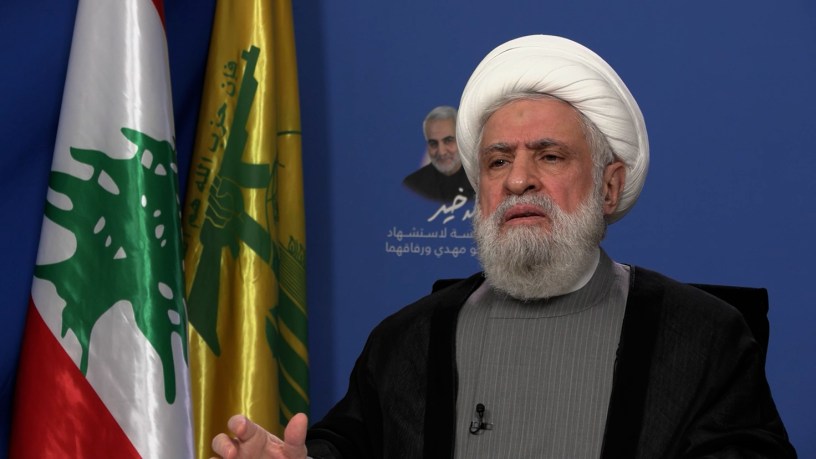
Full speech by Hezbollah Secretary General Sheikh Naïm Qassem on the fifth anniversary of the martyrdom of Commanders Qassem Soleimani and Abu Mahdi al-Muhandis, as well as on the latest developments, 4 January 2025.
Source: Al-Manar
Translation: Resistance News
- Introduction
- Qassem Soleimani and Abu Mahdi al-Muhandis
- Lessons from past and present resistance
- The ceasefire agreement
- False allegations against Hezbollah
- Tribute to Palestine and Yemen
- The presidential election
Introduction
In the name of God, the Compassionate, the Merciful. Praise be to God, Lord of all worlds. May peace and blessings be upon the noblest of all beings, our Master and beloved, Abul Qasim Muhammad, upon his pure and virtuous family, upon his chosen and loyal companions, and upon all prophets and the righteous until the Day of Judgment. May God’s peace, mercy, and blessings be upon you.
Today, we commemorate the fifth anniversary of the martyrdom of the great commander Hajj Qassem Soleimani, the great commander Hajj Abu Mahdi al-Muhandis, and their comrades who were martyred alongside them.
However, let me begin by congratulating the Islamic community on the arrival of the month of Rajab, a month in which God, in His infinite grace, pours out His mercy upon His servants. Let us seize this divine blessing to deepen our bond with Him through worship.
We also extend congratulations on the birth of Imam al-Baqir, the fifth Imam of the Ahl al-Bayt (peace be upon them), on the first day of Rajab, as well as the birth of Imam al-Hadi, the tenth Imam of the Ahl al-Bayt, on the second day of Rajab. Finally, we express our condolences for the commemoration of the martyrdom of Imam al-Hadi on the third day of Rajab, according to some traditions.
This brings us to our main event, after which I will address the political situation in Lebanon and the region.
Qassem Soleimani and Abu Mahdi al-Muhandis
Martyr Qassem Soleimani was a strategic leader celebrated for his intellectual, political, and jihadist vision. His personality shone through in his actions, his thought, his projects, and his achievements in both political and jihadist arenas.
I have chosen to emphasize three key aspects of the personality of this strategic leader, the guide of the Axis of Resistance, and the Master of the martyrs of this Axis.
The first aspect is Islamic authenticity. Hajj Qassem embodied the essence of original Muhammadan Islam, walking the path set by Imam Khomeini (may God sanctify his pure soul) and Imam Khamenei (may God preserve him). He fully embodied the teachings of the sacred Quranic verse:
“O you who believe, shall I guide you to a transaction that will save you from a painful punishment? Believe in God and His Messenger, and strive in the way of God with your wealth and your lives; that is better for you, if only you knew.”
What is the promise?
“He will forgive your sins, admit you to gardens beneath which rivers flow, and grant you pleasant dwellings in the Gardens of Eternity. That is the ultimate triumph.”
And in this life:
“And He will grant you another favour that you love: help from God and imminent victory. Give glad tidings to the believers.”
The second aspect is exposing US and Israeli plans. Martyr Qassem Soleimani unveiled the schemes of the United States, particularly in Iraq and Afghanistan, as well as their support for Isis. He fought against this system and thwarted successive American projects in the region. Additionally, he highlighted Israel’s role as a criminal, expansionist, and dangerous tool, rooted in the occupation of Palestine but aiming to dominate the entire region. By redefining the compass as the liberation of Palestine and Al-Quds (Jerusalem), he dealt significant blows to Israel. As the head of the Quds Force and the Axis of Resistance, he worked tirelessly to restore the prominence and centrality of the Palestinian cause through confrontation with the Israeli enemy.
The third aspect is that martyr Qassem Soleimani dedicated himself to developing the capabilities of the peoples of the Middle East. When he arrived, he encountered communities that were devout, virtuous, pure, and brimming with immense potential. He strengthened these capacities, provided the necessary resources, and devoted himself wholeheartedly to this mission. He stood beside the resistance fighters, working tirelessly day and night to supply resources, deliver training, enhance skills, refine strategic visions, and advance projects aimed at unifying the various fronts. His goal was to connect these different battlefields so they could mutually support one another in the service of the Palestinian cause. Thanks to his efforts, we now witness the resilience and steadfastness of the region’s peoples. The Palestinian cause has reclaimed its centrality, its universal dimension, and its renewed momentum, once again becoming the priority for the region’s peoples, for Muslims, and for freedom defenders worldwide.
Soleimani has been described by his peers as a “school,” a source of inspiration for his brothers, sons, and disciples in the Resistance. Sayed Hassan Nasrallah, one of his close companions, remarked, “Hajj Qassem achieved his ultimate aspiration by attaining the honor of martyrdom, becoming the Master of martyrs in the Axis of Resistance.” Soleimani remains a model and a banner whose legacy, with God’s help, will persist in confronting Israel until the disappearance of this usurping entity.
As for the martyred commander Abu Mahdi al-Muhandis, he stands as one of Iraq’s great symbols. He played a fundamental, significant, and influential role in leading this group of believers and mujahideen to liberate Iraq from the accursed Saddam, from America, the Great Satan, and from Isis, which invaded the country. He epitomizes the ideal of true commitment. This model of loyal and devoted commitment manifested itself under the wise guidance of the Marja’iyya (religious authorities) in Najaf al-Ashraf. His role was pivotal in founding the Popular Mobilization Forces (PMF). He is a soaring banner in the sky of the Nation, on the path to Palestine, for the glory of Iraq, and in the fight against the US occupation.
On the occasion of their anniversaries, these exemplary figures continue to inspire us. Our condolences and congratulations go to them and the martyrs who accompanied them. Our condolences and blessings extend to the virtuous martyrs, their families, their nations, their loved ones, and the Islamic Ummah. We also offer our condolences and blessings to the Master of the Age and Time (the hidden Imam al-Mahdi), may our souls sacrifice themselves for the dust of his footsteps.
Lessons from past and present resistance
Let me begin with general political observations. First, when the Israeli enemy invaded Lebanon in 1982, reaching the capital Beirut within days, we resisted. As the Islamic resistance, the national resistance, and alongside all honorable fighters, we held firm from 1982 to 2000, ultimately liberating this land in 18 years, thanks to the blessing of resistance. The lesson is clear: in 1982, Israel reached Beirut in just a few days. Yet in 2024, during the September aggression, Israel tried for 64 days to advance a few hundred meters before the aggression ended. Despite all its efforts, its soldiers and officers could not advance more than a few hundred meters along the front lines.
Why could Israel not reach the southern Litani River? Why could it not cross the river? Why could it not reach Beirut? Because the legendary and unwavering fighters of the Mujahideen resistance stood against the Israeli enemy. This is deterrence.
What is deterrence? When an army of five divisions, consisting of 72,000 soldiers and officers, mobilizes to cross borders and reach a river—or beyond—but fails, it demonstrates that the resistance is strong, dissuasive, and effective. It disrupts the enemy’s objectives. Despite the massive destruction inflicted by Israel and its criminal aggression that spared no human life, no stone, and nothing else, an agreement was reached. The enemy requested a ceasefire, which we accepted through the Lebanese state. At the time of the ceasefire, the resistance still retained significant capabilities and a strong presence on the ground. This proves that the battle did not cease due to a lack of resources or capacity. On the contrary, it was the resistance’s strength, potential, and sacrifices—its jihad, honor, and determination—that compelled the enemy to seek a ceasefire. These resistance fighters, with their unshakeable will and sacrificial resolve, categorically reject all forms of occupation.
Let us not forget: we faced an unprecedented aggression. We stood firm as a resistance, alongside our people and Lebanon. We broke the backbone of the plan aimed at ending the resistance. We broke Israel’s backbone. While it is true that the sacrifices were immense, it is precisely because of these sacrifices that we were able to preserve our dignity and survival. Had these sacrifices not been made, what would have been the result? The outcome would have been abandonment, the absence of resistance, Israel’s incursion, occupation, and eventual arrival in Beirut. But no, we are more dignified than that. The resistance will continue, God willing.
The Ceasefire Agreement
After the Battle of the Mighty Ones [name given by Hezbollah to the war against Israel from September to November], decisive results have been etched into history, and we must acknowledge them. This battle marked a turning point: the occupation of Lebanon can no longer persist without resistance. It is no longer conceivable that the Israeli enemy will carry out invasions at will, carve out territory in Lebanon to establish special zones, or plant Israeli settlements. What transpired during the Battle of the Mighty Ones thwarted Israel’s ambitions in Lebanon, thanks to the resistance, the people, the army, and the complementarity uniting them.
To understand this, let us draw a comparison with what occurred in Syria. Israel occupied a section of the Golan equivalent to one and a half times the size of Gaza. It targeted the capabilities of the Syrian army and people, granting itself complete freedom of action. It crippled Syria’s long-term potential and ensured that no confrontation could emanate from there. However, I firmly believe that in the future, the Syrian people will play a role in the confrontation with Israel, as they are a resilient, honorable people who aspire to dignity and freedom. This comparison is essential. What happened in Syria could have happened in Lebanon, had it not been for the resistance. This truth must be recorded in the annals of history: the resistance made all the difference.
The second point is that resistance is a choice. It is a cultural choice, a choice of faith, a political choice, a choice of jihad. The alternative is submission to the enemy, who seeks to impose its will, demanding we yield out of fear of immediate losses, while taking everything it desires in the long term. We have chosen resistance as an act of faith. It is our choice to liberate the land, protect sovereignty, support Palestine, and defend justice in the face of Israel’s expansionist occupation.
For this resistance to exist and achieve results, it must rest on two essential pillars:
- Faith and determination.
- Preparation and practical capabilities to transform this faith into tangible action.
Let me be absolutely clear: it is the leadership of the resistance that decides when to resist, how to resist, what methods to employ, and which weapons to use. No one should assume that the presence of resistance automatically means it will react to every incident or respond systematically. Who sets the rules for resistance? The resistance itself defines its own rules. For instance, there is no predetermined schedule for resistance actions, either within the agreement or after the expiration of the 60-day period stipulated in it.
We have stated that we are giving an opportunity to prevent Israeli violations and to allow the agreement’s implementation. However, this does not mean our patience is confined to 60 days, nor that it will necessarily be shorter or longer than that timeframe. Our patience is contingent upon our own decision about the appropriate moment to confront Israeli aggression and its violations. It may run out before the 60 days, or it may extend beyond them. It is the leadership of the resistance that determines when to exercise patience, when to act, and when to respond. Therefore, I urge you not to tire yourselves with political analyses or speculations about Hezbollah’s actions. What will happen after these 60 days? What will happen before that in case of aggression? When we decide to act, you will see for yourselves. There are no imposed rules of silence or initiative; it is our sovereign decision.
As for the agreement, it establishes a blockade south of the Litani River and requires Israel to withdraw. The Lebanese state, of which we are a part, is now responsible for monitoring this agreement with the guarantors to compel Israel to respect and implement its provisions. The Battle of the Mighty Ones demonstrated the legitimacy and significance of the resistance, which emerged victorious and with its head held high. It shattered the occupation project and ensured the survival of the resistance.
False Allegations Against Hezbollah
The third point concerns the various labels and claims that some people use to describe the outcomes of Israeli aggression, aiming to demoralize the resistance and its supporters. I will mention some of these expressions to clarify matters and prevent people from being misled by words devoid of facts and reality.
They claim that the resistance is weakened, but this is far from true. Just ten days after the martyrdom of Sayed Hassan Nasrallah, the Master of the martyrs of the resistance, it began to recover. Analysts and observers alike have noted its strong return to the field. The resistance has resurged powerfully, and was bolstered by the ceasefire agreement and supported by the blessings of the resistance fighters, the people, the cause’s supporters, the martyrs, the wounded, the prisoners, and all those who have offered what is most precious to them. The resistance remains strong.
They allege that the enemy has struck the resistance’s capabilities. But if that were the case, what stopped the enemy during those 64 days? Why didn’t they continue their aggression? When the enemy concluded this agreement with the Lebanese state, the resistance’s capabilities were intact and strong enough to endure for much longer. Those capabilities remain fully present.
They say the resistance has retreated. To this, I respond: the resistance is not merely about weapons. Above all, the resistance is faith, conviction. This faith is unshaken, reinforced, and deeply rooted. Go and listen to the children, the women, the elders. Look at the wounded, whether struck by recent attacks or injured in past battles. Hear what they are saying. They are ready to endure their suffering again, to offer more of their children, to remain in the fight and sacrifice everything. This demonstrates that the resistance has grown even more deeply entrenched, stronger, and prepared to instill its principles in future generations. The resistance has not retreated; it has solidified and will continue to grow stronger.
Our morale remains high despite the wounds and pain. As the Qur’an says: “And to God belongs the glory, and to His Messenger, and to the believers.”
They say that many of our brothers have been martyred. May God make it a blessing! Do you truly believe that the fall of martyrs means we have lost? No, martyrdom is a goal for these individuals. Each of them, as their hour draws near, prays to Almighty God: “Lord, when my time comes, let me be in the heart of the battle.” This is the most noble of ideals, surpassing all forms of virtue, for there is no greater act of devotion than for a person to sacrifice themselves in the path of God.
Thus, when we speak of the martyrs, we address their families, saying: “We offer our condolences for the loss of your loved ones—an entirely natural feeling—but we also congratulate you, for they have achieved what they ardently desired.” The blood of the martyrs benefits them before God, while strengthening the march of jihad here on Earth. These accumulated sacrifices fortify the Resistance and bring us closer to victory. God Almighty says in His sacred Book: “Those who believe in God and His messengers, they are the truthful and the martyrs in the sight of their Lord. They will have their reward and their light.”
Martyrs revive our future and illuminate our path, just as Imam Hussein (peace be upon him) did when he sacrificed himself alongside more than 70 companions, including children and family members. The women of his household were taken captive, and Zaynab, the first to give voice to this event, immortalized the tragedy. The martyrdom of Imam Hussein (peace be upon him) revived the Islamic Ummah after him. By the blessing of his sacrifice, we continue to defend the truth against falsehood.
To those who say that the material damage is significant, we respond that it is merely a test. It is just a trial, and thanks to God, we have not failed. Material losses will be compensated, by God’s grace. What matters is that the project (of resistance) has not faltered.
A thought came to me: “Every birth comes with pain and hope.” Even a newborn cries at birth, but later, that child grows strong. Every birth is accompanied by pain and hope. The battle of the Mighty Ones is a new birth for Lebanon, a nation resisting occupation and carrying the hope of the future with the pride of its children, the pride of its cedars. Lebanon is an independent country, not under the control of the United States or Israel. In any case, come and see us, and you will find the future.
Some may attempt to philosophize, saying: “Oh, you poor people, I don’t know what has befallen you.” No, it is not like that. This is a test we have passed, thanks to God. As always, there are those who are agitated, disturbed, nervous—people who analyze and cast accusations. But they are the ones who suffer because they did not expect the Resistance to emerge strong, tall, and proud, its head held high. Sacrifices have been made, and it is through these sacrifices that the foundations of the future are laid.
Tribute to Palestine and Yemen
Today, we must always maintain a humanitarian and just vision. By God, is what is happening in Palestine reasonable? Over 155,000 martyrs and wounded, more than two million people displaced and living in tents—during winter, no less. Israel is starving them, exterminating them, and daily massacres have become a normalized reality. Meanwhile, the United States, France, Great Britain, and all the other major powers stand by as spectators. Is this not injustice, oppression, demonization, and a perversion of humanity that must be confronted?
And yet, who are this exceptional, historic Palestinian people? For 13, 14, even 15 months, they have resisted for their survival—unyielding, enduring, and fighting. This people can rightfully claim to be among the greatest, if not the greatest, of nations, given the sacrifices they have offered. This people will endure. Yes, their homes have been destroyed, their children killed, their women murdered. But their faith remains—and will remain. The resistance continues.
We must extend a special greeting to Yemen—its leaders, its people, and its army. Yemen stands as a remarkable example, capable of addressing the entire world, particularly the Arab and Islamic countries that claim to defend human rights: “Look at Yemen. Look at Yemen, poor in resources but rich in its people, its leaders, its faith, and its determination. Observe what it is accomplishing, starting from nothing, creating something in the face of the Israeli enemy—and not just the Israeli enemy, but also the United States, Britain, and their allies, all united in supporting Israeli injustice and the extermination of the Palestinians.”
That is where we should stand—not elsewhere. We should not ask, “Why are you fighting?” but rather, “Why are you not fighting for justice?” This is the fundamental question.
The Presidential Election
I will conclude by saying that Hezbollah seeks to elect a president based on cooperation and mutual understanding between political blocs, in public sessions. This consensus is a golden opportunity to turn a new page toward a positive direction for Lebanon. The nihilists stand no chance. Foreign powers cannot impose their will on this right through their might.
We aim to conclude January 9 by electing a new president for a new, positive, and cooperative phase that will lead to stability. We are working to strengthen national unity and Islamic unity, as well as all forms of internal cooperation, to ensure the stability and prosperity of our country, move it forward, and contribute to the reconstruction of our nation.
May God’s peace and mercy be upon you.
To support our work, you can donate, share this article and subscribe to our newsletter.
 Resistance News Unfiltered