
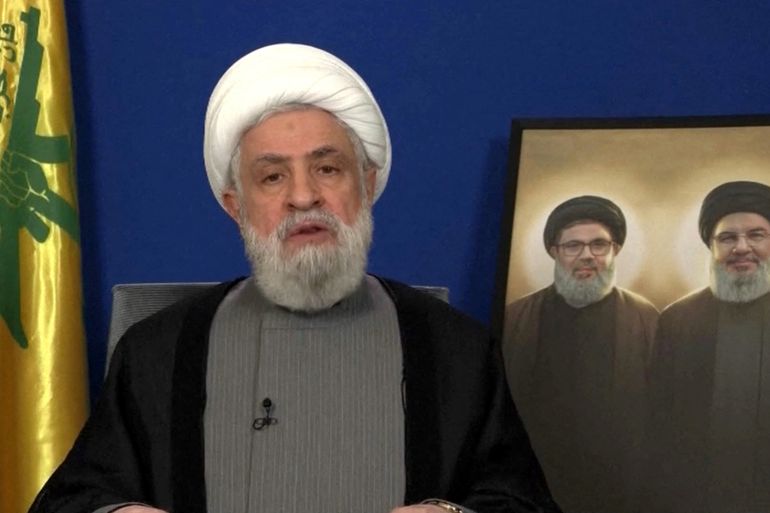
Full Transcript of Sheikh Naim Qassem’s Speech, Hezbollah Secretary-General, on November 20, 2024, Addressing Recent Developments.
Source : Al-Jazeera
Translation : resistancenews.org
Introduction
The battlefield
Negotiations and ceasefire
A war of attrition
Conclusion
Introduction
In the Name of God, Most Gracious, Most Merciful.
Praise be to God, Lord of the Worlds. May prayers and salutations be upon the most deserving of creatures, our master, beloved leader, (the Prophet) Abul-Qassim Mohammad, upon his noble and pure family, upon his pious chosen companions, and upon all the Prophets and Righteous, until the Day of Judgment.
Peace be upon you, and God’s Mercy and Blessings.
A week has passed since the 40th day of commemoration of the martyr, His Eminence Sayyed Hashim Safieddine, Head of Hezbollah’s Executive Council. I find it fitting to both mourn and congratulate this martyr. As the Almighty says in His noble Book: “The believers are only those who have believed in God and His Messenger, and then doubt not, but strive with their wealth and their lives in the way of God. It is they who are the truthful.” (Quran, 49:15)
My dear brother, His Eminence Sayyed al-Hashemi, may God’s mercy be upon you. O my companion on this divine path of resistance, I knew you as a genuine, cultured, conscious, and purposeful person. Your leadership of the Executive Council was unceasing, covering cultural, organizational, health, and social efforts, as well as women’s and scouting activities. You worked tirelessly, day and night, and were a steadfast support to His Eminence, the nation’s martyr-leader Sayyed Hassan Nasrallah, may God be pleased with him, his right hand, and a constant presence in the field alongside the resistance and its needs. You truly embody the Almighty’s words: “It is they who are the truthful.”
Your departure is a loss for us, but you have triumphed. Blessed are you in your ascent alongside Muhammad and his family, peace and blessings be upon them, with the martyrs and mujahideen. With our greatest leader, His Eminence Sayyed Hassan Nasrallah, may God be pleased with him, the martyrs Ismail Haniyeh, Yahya Sinwar, Qassem Soleimani, and all the martyrs and righteous. We extend our condolences, salutations, and congratulations for this monumental jihad and martyrdom.
We must also honor, in this introduction, the martyrdom of our dear brother and head of Hezbollah’s media relations, Hajj Muhammad Afif al-Nabulsi. He fell as a martyr in the field of media jihad, on the path of Al-Quds (Jerusalem) and its liberation. Hajj Muhammad was a media icon, dedicated and diligent, with strategic vision and vast knowledge. He took the initiative to hold press conferences to address key media gaps: exposing the enemy, highlighting the resistance’s achievements, and countering the fabrications leveled against Hezbollah and the resistance. His openness to diverse media outlets was remarkable, and his innovative ideas irritated the enemy greatly. This is why they assassinated him. They feared him, but while they killed his body, they can never extinguish the spirit of resistance. We offer blessings and condolences to the martyr Hajj Muhammad Afif al-Nabulsi, along with his fellow martyrs—Hussein Ramadan, Musa Haidar, Mahmoud al-Sharqawi, and Hilal Termes—and we pray for the wounded to recover swiftly, God willing.
O sacred martyr, you were martyred in the Ras al-Nabaa area of Beirut, as the Israeli enemy attacked the capital. You were in a civilian, media, and political role that should have been protected. Yet the Israeli enemy did not stop there. They also attacked the Mar Elias area, targeting a shop, and the Zoqaq al-Balat area, striking a residential apartment. They bombarded, assassinated, and violated the heart of Beirut. The enemy should expect our retaliation to strike the heart of Tel Aviv. We will not leave our capital vulnerable to the Israeli enemy’s blows without ensuring they pay the price, and that price is the heart of Tel Aviv. I hope the enemy understands that these matters cannot go by idly.
I extend my gratitude to everyone who offered condolences and congratulations on the martyrdom of our revered Secretary-General, the master of the nation’s martyrs, Sayyed Hassan Nasrallah, and the leading martyrs alongside him. Thank you to all who sent telegrams, made calls, or reached out to our dear brothers. Given our current circumstances, I thank everyone for their words of condolence and congratulations. I also thank everyone who supported Hezbollah’s decision in appointing the new Secretary-General. This decision garnered significant media attention and personal messages. I thank you all on behalf of the party and the resistance. God willing, we will continue this journey and safeguard the trust—the trust of the martyrs.
The battlefield
Today, I wish to address several topics relevant to our battlefield and our situation.
Firstly, in Lebanon, we have faced two battles over two phases. The first was the battle to support Gaza over 11 months—steadfast Gaza, wounded Gaza, the Gaza that sacrificed martyrs. We ensured our efforts and jihad were aligned with what we could offer to Gaza and Palestine while considering Lebanon’s conditions and what would best serve Gaza. Praise be to God, we undertook a significant mission.
We are honored to stand among the few who supported the truth, alongside proud Iraq, resilient Yemen, and the Islamic Republic of Iran, with its leadership, its guards, and its people, in this noble stance. Meanwhile, the world watched in silence as over 45,000 martyrs fell, 105,000 were wounded, and 2.5 million were displaced, enduring hunger, thirst, and destruction. Where is the so-called free world? Alas, the answer lies with future generations.
The second battle began two months ago, its precursors dating back to September 17th with the issue of the booby-trapped pagers. We named this battle the Battle of the Mighty Ones, as it was launched to repel the comprehensive Israeli aggression against Lebanon. In reality, Israel does not need a pretext. For those who argue that our support for Gaza gave Israel a motive to attack Lebanon, no, Israel does not require one. In any case, we had agreed to the Biden-Macron proposal on September 23rd, based on the idea that a solution could be found to halt the aggression. However, they assassinated our Secretary-General on September 27th, and this battle continued.
Hezbollah underwent a real state of confusion for ten days, then we managed to reorganize and regain our political, resistance, media, and overall strength, thanks to God Almighty. Although the blows we endured were both painful and devastating—powerful enough to topple nations, parties, and armies—thankfully, we are blessed with the strength of the most resilient people to help us face and overcome these trials.
What was the outcome of this two-month battle? The result was a legendary steadfastness of the resistance in Lebanon, as both friend and foe have witnessed. We had expected the frontline to last for 15 days, after which Israel would move to the second phase, but it turned out to last for a month and a half. This is proof of the strength of the mujahideen and an indication that the enemy is afraid to advance due to the losses it suffered at the outset of its attempt to progress, and the further losses it would incur if it continued. More than 100 Israeli soldiers were killed and over a thousand wounded during this brief period. The mujahideen launched strikes from the frontline areas after Israel announced its entry into those regions. They didn’t fire ordinary rockets—when rockets are launched from Maroun al-Ras, near Maroun al-Ras, toward Haifa, which is 40 kilometers away, it shows that the resistance is widespread and has a significant and influential presence, thanks to God. The firing of rockets and drones remained at a high level. Hundreds of thousands of Israelis were displaced from their homes. This is one of the results of this battle and confrontation. Even the new Israeli foreign minister, Saar, altered the goals, stating: “Our goal is not to destroy Hezbollah.”
They moved to the second phase because they want a battle that brings them all the gains, but they are incapable of fighting it. The resistance is not an army; it does not work to prevent the army from advancing. The resistance fights the army wherever it advances to inflict casualties on it. This means that if the army enters one or more villages, the resistance fighters will be inside valleys, caves, behind trees, in some houses, or in fortified positions. Therefore, it is not important to say whether the army entered, left, or approached a village. The key question is: how many enemy soldiers were killed that day? How many were wounded? Where did the mujahideen confront them? The mujahideen faced them along the entire front, by the grace of God.
The resistance works to kill the enemy and prevent the stability of its occupation. In fact, as a resistance, we have set an exceptional example. There is strength among the fighters, those who face hardship with steadfastness. You know, sometimes we suffer because some brothers ask to go to the frontline, and we tell them, “Be patient,” because there are enough fighters, thank God, who are steadfast and firm in their positions. We have sufficient capacity, by the grace of God.
I tell you that despite the resources allocated to their places, we also transfer capabilities to the frontline, and there is a rotation of resistance fighters until the villages on the frontline. This means the path is clear. How can the path be clear when the enemy controls the skies completely? With God’s help, and the brothers know the geography well and have the courage to advance. In any case, this enemy, which was lured into this location, will incur many losses. In the end, the land is ours, it’s our youth facing them, and the resistance is from this land. The Israeli occupier cannot settle, continue, or advance in our land. He is an occupier and will be expelled, God willing.
We affirm that the discourse is grounded in the field, and the outcomes are based on the field in both of its components: the field of ground confrontation and the field of launching rockets, missiles and drones deep into the usurping entity. The resistance has the capacity to continue at this pace for an extended period. You can observe that the daily strikes are never routine. There is always a formation—our fighters target a new barracks, a new settlement with a barracks, and so on, varying in distances and directions: sometimes 100 kilometers, sometimes 150, 125, 40, or 30 kilometers, and so forth. This is all part of a program planned in advance, with fire coordination between the various fighting forces. Israel cannot defeat us or impose its conditions on us. We are the men of the field, and we will remain in the field, God willing.
Negotiations and ceasefire
Here lies the fundamental question: What is the solution? They now claim there is a proposal for negotiations. We received this proposal, read it carefully, and made our observations. We have observations, and President Berri [Speaker of the Lebanese Parliament] has his own. This means that all of our observations—those of the resistance and the state—are aligned, God willing. These observations were presented to the American envoy, and we discussed them in detail. We decided not to speak in the media about the content of the agreement or our observations. We chose to lead this discussion quietly, to see if it will reach a result. In the end, the Israeli side expects to gain through an agreement what it failed to achieve on the battlefield, which is impossible. The observations we made indicate that we are agreeable to this path of indirect negotiations through President Berri, should the other party desire this. If they wish, they should let us know, and we will see what the outcome will be.
Do we expect these negotiations to quickly result in a ceasefire and an end to the aggression? No one can guarantee that because it depends on Israel’s response and Netanyahu’s seriousness. But let it be known that we are negotiating under two conditions: one is the complete and total cessation of aggression, and the second is the preservation of Lebanese sovereignty. The Israeli enemy has no right to violate our borders, kill, or enter whenever it wishes under various pretexts. Lebanon must be protected.
We have prepared for a long battle, and we are negotiating now, but not under fire, as they say, because Israel is also under fire. In other words, we have decided on two parallel tracks: the battlefield track, which escalates according to the evolving field data and continues with steadfastness and perseverance, God willing; and the negotiations track. This means we do not link the battlefield to the negotiations. If, hypothetically, the negotiations fail after some time, we will continue on the battlefield, regardless of the outcome. If the negotiations succeed, then the battlefield will be part of the success of these negotiations.
A war of attrition
As for those who say it will be a war of attrition, yes, a war of attrition against the Israeli enemy because we have only one decision: steadfastness and persistence, even if it takes time. You say we are in a state of attrition—yes, but we endure this attrition because we are defending our land, our homeland, and our Lebanon. This is a responsibility that falls upon us and others. We have decided to be the people of either victory or martyrdom. We believe in God’s promise: “O ye who believe! If ye will aid the cause of God, He will aid you, and plant your feet firmly.” (Quran, 47:7)
I salute the mujahideen in the battlefield, because they are the ones who have given us this momentum, this strength, this determination, and this resolve. Also, a salute to our people who rally around us. Who are they? These are the parents whose children are at the front lines, who are displaced, who suffer, who endure, but are always grateful and hopeful for victory, ready to offer martyrs. This is the model that fortifies the resistance and strengthens it in the face of challenges. I was struck by an interview with a woman, and when the interviewer asked her, “How many martyrs do you have?” she replied, “I have three sons who are martyrs, two grandsons who are martyrs, two sons-in-law who are martyrs—seven martyrs in total.” The interviewer asked: “What do you have to say?” She told him: “By God, whatever we do is little compared to the (sacrifices of the) Ahl al-Bayt (the Prophet’s family, peace be upon them). These martyrs have honored me before Lady Zahra and Lady Zaynab (peace be upon them). Now I tell you, if the resistance says that I am needed to go and sacrifice myself, I am ready to give myself and all that I have left.” A group like this, and a woman like her, God can only honor them and those with her from the mujahideen.
We are between two choices: the sword or humiliation. The sword means fighting, while humiliation means surrender, leaving us with nothing. We will never accept humiliation, and that’s why we continue in the field. Some people ask: “Why is the cost so high for you?” Why is the cost so high for us? Because we face a monstrous enemy that kills civilians and destroys all life. We are up against Israeli human monsters, supported by even greater American human monsters. What do you want us to do in the face of this monster, who commits these acts to scare us into surrendering, so he can take everything for free, grab our land whenever he wants, if we surrender to him? No, never.
This Israel cannot do as he wishes. We will stay in the field and continue fighting, no matter how high the cost. We will make the cost high for the enemy as well. He too suffers, and the cost is high for him too. No one can come and hold us responsible, saying, “Look at what’s happening”, it’s Israel who is attacking. Let him stop his attacks. We are in a position of response and defense. To those who ask us “Can you, with your capabilities, win against the enemy?” Today, I wanted to clarify the meaning of victory that we talk about. We cannot expect a resistance in front of an army with such potential and capabilities to gain ground without losses or sacrifices. It is not possible. But I tell you, the enemy has goals. When the enemy fails to achieve its goals, it means we have won. Every resistance in the world pays a heavy price, but in the end, its value lies in the fact that it did not allow the enemy to achieve its goals. That is why we say we have won. We are confronting the enemy’s goals in Lebanon, and God willing, we will emerge stronger because we resisted, sacrificed, gave, and did not allow the enemy to achieve its objectives. This is also because of our cohesion and cooperation.
Conclusion
I say to the displaced from our families and loved ones, whether at home or in displacement centers: we appreciate what you are doing and giving, and we know you are sacrificing a lot. We are doing all we can to provide aid and cooperation through our brothers and associations, and in cooperation with others. You need patience, and you are people of patience, as you say yourself. God willing, He will open the way for us, and we will continue to cooperate.
Hezbollah and Amal are no different from each other—neither in the field, nor in sacrifice, nor in presence. We are one family in one homeland. In fact, I wish the whole country were like this. Yes, I say that those who supported and sheltered the displaced, and those who helped, are an integral part of this true national resistance. Today, we resist in Lebanon to defend Lebanon and its people from the Israeli occupation, which was only driven out by resistance and defeated by resistance. We will continue on this path, God willing.
I renew my thanks to all our countrymen, to all families, to all sects, to all municipalities, to all those who strive. Know that this is a credit to you, both in this world and the hereafter, because it affects the building of the country and our cooperation together.
There is another topic I wanted to address, but I will discuss it later, as it’s not related to the current details. However, I want to tell you that during this battle, we are thinking about the future of our country. Let me be clear: We have not changed our positions, and we will not change or alter these patriotic, honorable, resistance-based positions. We believe in the unity of the army, the people, and the resistance, which is the remaining foundation upon which we can build our country.
There are four things to keep in mind after the cessation of the aggression, God willing: First, we will rebuild together, in cooperation with the state and all honorable nations and forces that will assist in reconstruction. God willing, Lebanon will return more beautiful and better. Second, we will make our effective contribution to the election of the President of the Republic through the parliament in a constitutional manner. Third, our political steps and state affairs will be under the umbrella of the Taif Agreement, in cooperation with the political forces. Fourth, we will be present in the political field with our representative and popular power, and our significant presence for the benefit of the homeland, to build and protect it, and maintain peace.
Peace be upon you.
To support our work, share this article and subscribe to our newsletter. All donations to our website will be sent to Lebanon to assist the displaced.
 Resistance News Unfiltered
Thank you so much for your regular newsletter and translations.
I post them each time I get them: https://globalsouth.co/2024/11/24/naim-qassem-we-are-prepared-for-a-prolonged-battle-lebanons-sovereignty-is-non-negotiable/
Blessings
Amarynth at GlobalSouth.co
LikeLike